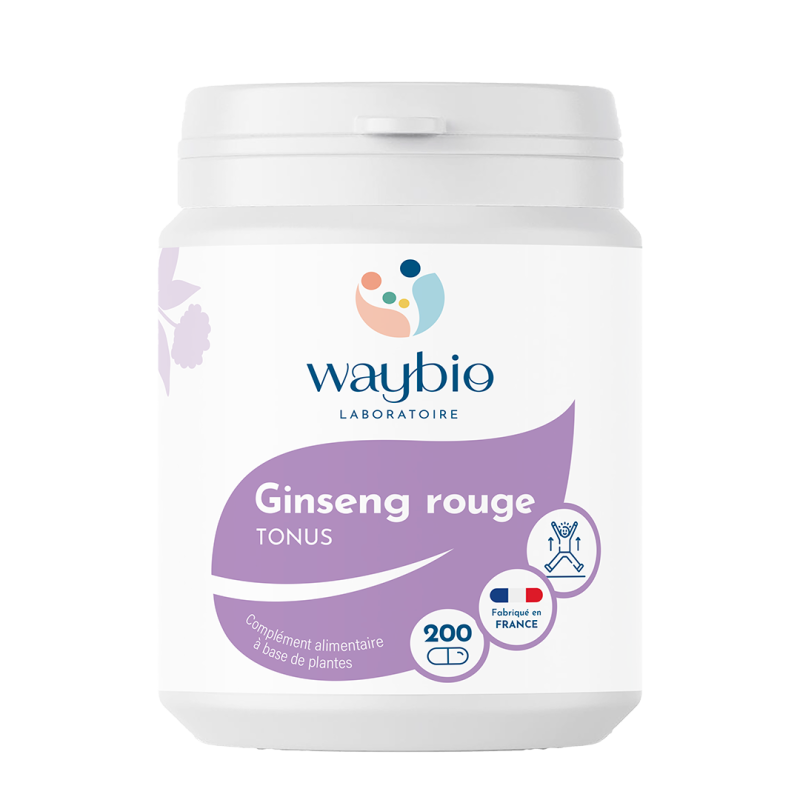
Tonic support for demanding periodsWaybio Ginseng rouge is an
organic formula devoted exclusively to ginseng. A serving of
six capsules provides 1,800 mg of the plant.
Ginseng rouge has a
tonic and adaptogenic profile. It supports the body when physical or mental demands increase:
a demanding work schedule, physical activity, examination periods, seasonal changes or temporary fatigue.
An adaptogenic plant does not act exactly like a stimulant. Instead, it helps the body
adjust its response to everyday pressures, helping preserve regular energy and concentration levels for longer. Ginseng
does not naturally contain caffeine, and this formula contains no source of caffeine.
An effect on energy utilisationEach cell produces its energy in small structures called
mitochondria. These convert nutrients into
ATP, the form of energy that muscles, the brain and other organs can use directly.
Ginsenosides, ginseng’s main characteristic constituents, are associated with several mechanisms related to
glucose utilisation, mitochondrial function and the balance between energy production and expenditure. They can also support the
antioxidant systems that protect cells against reactive molecules naturally produced during exertion or periods of intense activity.
This gradual action explains why ginseng is primarily used to
maintain vitality and stamina, rather than to cause an immediate stimulant effect comparable to coffee.
A more balanced response to stressIn stressful situations, the brain communicates with the adrenal glands through a hormonal circuit responsible for organising the body’s response. This system notably acts on
cortisol, heart rate, alertness and energy availability.
Ginsenosides contribute to
modulating several signals involved in this response. Ginseng can therefore support the ability to
remain engaged during a demanding period while promoting a return to a more stable state once the demand has passed.
This regulation helps explain ginseng’s dual image as a plant that is both
tonic and conducive to better emotional adaptation. It is not a sedative, but support designed to make the stress response more regular.
Physical and mental supportMuscles and the brain are particularly sensitive to
energy availability. By supporting nutrient utilisation and oxidative balance, ginseng may be relevant for:
•
maintaining tone during a period of temporary fatigue;
•
supporting stamina in the face of a demanding physical pace;
•
preserving alertness and mental availability;
•
supporting concentration during long or demanding days;
•
promoting a more stable feeling of vitality.
Natural defences and antioxidant balanceGinseng also contains
polysaccharides and various phenolic compounds. These constituents complement the action of ginsenosides by contributing to
antioxidant balance and communication between immune system cells.
The cells responsible for identifying and neutralising external agents need to be able to react effectively, then return to their resting state. Ginseng’s adaptogenic nature corresponds to this
support for regulation, rather than permanent or excessive stimulation of the defences.
This action highlights the value of ginseng during
seasonal changes or periods of intense demand.
Why is ginseng red?Ginseng rouge is generally obtained from the root of
Panax ginseng. The fresh root is first
steamed and then dried. By contrast, white ginseng is dried without this initial cooking process.
Steaming naturally alters the root’s profile. Some ginsenosides lose some of the sugars attached to their structure and are transformed into compounds such as
Rg3, Rg5 or Rk1. Heat also causes browning reactions that gradually give the root its reddish colour.
These transformations produce a
profile different from that of white ginseng.
An emblematic Asian rootPanax ginseng belongs to the
Araliaceae family. This perennial plant is native to a region extending from
the Russian Far East through Manchuria to Korea. Its root develops slowly and can take a shape reminiscent of the human figure. This characteristic is the origin of the traditional expression
“man-root”.
Who is this product for?Ginseng rouge may be particularly suitable for:
• people experiencing a
temporary drop in vitality;
• those going through a
demanding professional or intellectual period;
• students wishing to support their
concentration and resilience to their workload;
• physically active people seeking
adaptogenic support;
• those wishing to maintain their
vitality during a seasonal change;
• people experiencing
temporary stress who are looking for a caffeine-free tonic;
• users who favour a
single-plant formula from organic farming.
What does the science say?A clinical trial using exactly 1.8 g of Ginseng rougeA
randomised, double-blind, placebo-controlled trial was conducted in
Shanghai, China, between March and December 2017. It was published in 2019 in the
Journal of Ginseng Research.
Its main aim was to assess the tolerance of two doses of Korean Ginseng rouge.
Changes in fatigue were one of the main efficacy criteria.
The trial included
180 women and men aged 18 to 60, with a profile described as “deficiency syndrome” according to traditional Chinese medicine criteria. The average age was approximately 36, and
69.4% of participants were women. In total,
174 people completed the four-week intervention.
Participants were divided into three groups of 60 people:
• a
placebo;
•
1.8 g of Korean Ginseng rouge per day;
•
3.6 g of Korean Ginseng rouge per day.
The Ginseng rouge capsules were
standardised to between 3.5 and 4.8% total saponins. Their profile notably included the ginsenosides
Re, Rf, Rg2, Rh1, Rb1, Rc, Rb2, Rd and Rg3. The placebo capsules had a comparable appearance, weight, colour and taste.
Fatigue was assessed each week using a
23-item questionnaire covering physical fatigue, mental fatigue and its consequences in daily life.
After four weeks, the average decrease in fatigue score was:
•
−0.38 ± 0.13 with placebo;
•
−0.48 ± 0.19 with 1.8 g of Ginseng rouge, representing a significantly greater improvement than placebo;
•
−0.58 ± 0.20 with 3.6 g, with an even more pronounced difference compared with placebo.
At the end of the intervention, the score combining symptoms associated with reduced vitality reached
0.53 ± 0.34 in the placebo group, compared with 0.33 ± 0.24 with 1.8 g and 0.33 ± 0.23 with 3.6 g of Ginseng rouge.
These results indicate that a
characterised and standardised Ginseng rouge can improve perceived fatigue after four weeks, notably at a dose of
1.8 g per day. This amount corresponds to the
daily weight provided by six Waybio capsules.
Reference: Zhang L., Chen X., Cheng Y., Chen Q., Tan H., Son D., Chang D., Bian Z., Fang H., Xu H.
Safety and antifatigue effect of Korean Ginseng rouge: a randomized, double-blind, and placebo-controlled clinical trial. Journal of Ginseng Research. 2019;43(4):676–683.
DOI: 10.1016/j.jgr.2019.05.006 —
Full text.





 Tone
Tone
.png) Expertise based on experience and science
Expertise based on experience and science.png) Certified products
Certified products The best of nature