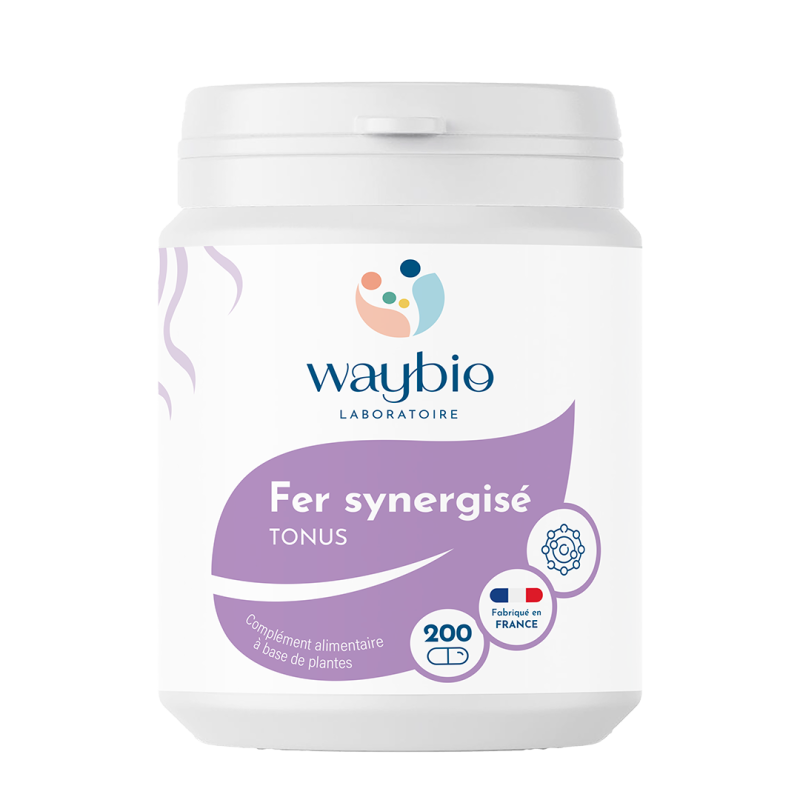
Fer synergisé combines several micronutrients involved in complementary functions related to energy and oxygen transport. For six capsules, the formula provides 14 mg of iron, as well as 100% of the nutrient reference values for vitamins C, B9 and B12.
Iron plays a central role: it contributes to the normal formation of red blood cells and hemoglobin, oxygen transport, energy metabolism and the normal function of the immune system. It also contributes to the reduction of fatigue.
Vitamins B9 and B12 complement this action in relation to blood. Folate contributes to normal blood formation, while vitamin B12 is involved in the normal formation of red blood cells and the normal function of the nervous system. Both also contribute to reducing fatigue.
Provided by acerola extract, vitamin C plays a particularly relevant dual role: it also contributes to energy metabolism and the reduction of fatigue, while increasing iron absorption. It also helps protect cells against oxidative stress and supports the normal function of the immune system. These functions are recognized by European regulations on health claims.
Spirulina completes the formula with 1,356 mg per reference daily dose.
Key strengths
• 14 mg of iron per six capsules, equivalent to 100% of the stated NRV;
• vitamins C, B9 and B12 at 100% of the NRV per six capsules;
• vitamin C provided by acerola extract;
• organically grown spirulina and acerola;
• iron in gluconate form;
• presented in plant-based capsules;
• bottle of 200 capsules.
Who is this product for?
Given its composition, Fer synergisé may be particularly relevant for:
• people whose diet provides little iron;
• women with heavy menstrual losses, identified by ANSES as a group with higher requirements;
• people who consume few sources of heme iron, particularly as part of a predominantly plant-based diet;
• people experiencing persistent fatigue when low or borderline iron status has been established;
• people looking for a formula that combines iron, vitamins involved in blood formation and vitamin C to support iron absorption.
Persistent fatigue can have many causes. If low iron is suspected, an assessment including hemoglobin and ferritin can help determine whether supplementation is appropriate.
A coherent combination
The most relevant combination is iron with vitamin C and vitamins B9 and B12.
• Iron is the main ingredient for benefits related to oxygen transport and hemoglobin formation.
• Vitamin C supports its absorption. EFSA considers that a cause-and-effect relationship has been established between vitamin C consumption and the increase in non-heme iron absorption.
• Vitamin B9 contributes to normal blood formation.
• Vitamin B12 contributes to the normal formation of red blood cells.
• All four micronutrients contribute, directly or through complementary functions, to energy metabolism or the reduction of fatigue.
Iron is at the heart of the formula, contributing to the formation of hemoglobin and normal oxygen transport. Vitamin C from acerola supports its absorption, while vitamins B9 and B12 complement this action by contributing to the normal formation of blood and red blood cells. A targeted combination designed to support the body’s energy and help reduce fatigue.
What science says
Iron for fatigue in non-anemic women
A clinical study published in 2012 investigated whether iron supplementation could reduce unexplained fatigue in women with low iron stores who were not anemic.
The trial was conducted in 44 general practices in France. It included 198 menstruating women aged 18 to 53 who experienced significant fatigue and had ferritin below 50 µg/L and hemoglobin above 12 g/dL.
For 12 weeks:
• 102 participants received 80 mg of elemental iron per day as prolonged-release ferrous sulfate;
• 96 received a placebo identical in appearance and taste;
• treatment allocation was randomized and double-blind.
At the end of the study, the fatigue score had decreased by 47.7% in the supplemented group, compared with 28.8% with placebo. The difference between the two groups reached 18.9 percentage points, with an adjusted difference of 3.46 points on the fatigue scale used.
Compared with placebo, supplementation also resulted in:
• an increase in ferritin of 11.4 µg/L;
• an increase in hemoglobin of 0.32 g/dL.
Origin, history and manufacturing
Spirulina
Spirulina sold as a food generally consists of a biomass of filamentous cyanobacteria of the Arthrospira genus, particularly Arthrospira platensis. It grows naturally in warm, alkaline waters. Its traditional use as food is documented in several regions of Africa, where it was harvested, dried and then consumed.
In controlled production, it is grown in ponds and then harvested by filtration. The biomass is then washed, drained and dried before being ground into powder. Quality depends in particular on control of the cultivation water, harvest hygiene and drying conditions.
Acerola
Acerola, identified as Malpighia emarginata, is a small fruit native to the Caribbean, Central America and northern South America. Its naturally high vitamin C content has encouraged its industrial development, particularly in Brazil.
For food supplements, the fruit is sorted, washed and processed into juice or pulp, then concentrated and dried to obtain a powdered extract. As vitamin C is sensitive to heat, oxygen and storage, processing conditions strongly influence its preservation.
Iron gluconate
Ferrous gluconate is a salt in which iron is combined with gluconic acid. It is listed by the Joint FAO/WHO Expert Committee as a nutritional source of iron and is among the forms permitted in European food supplements.
It is produced by reacting a source of divalent iron with gluconic acid or a gluconate, followed by purification and drying.





 Tone
Tone
.png) Expertise based on experience and science
Expertise based on experience and science.png) Certified products
Certified products The best of nature