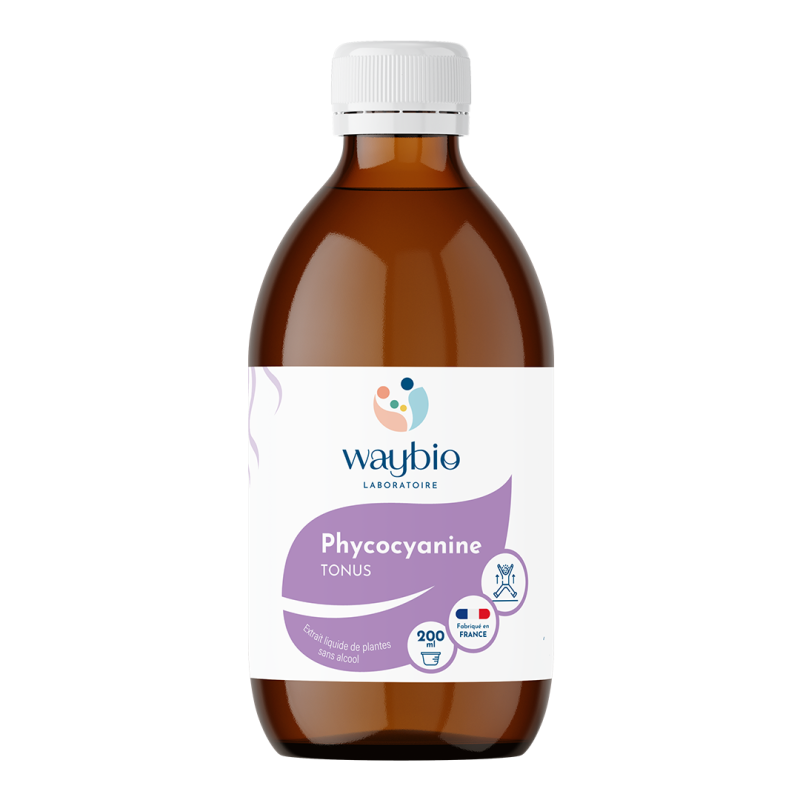
Phycocyanine is a
liquid formula to dilute providing, per
two 20 ml capfuls,
2,300 mg of spirulina extract, including
60 mg of phycocyanin at a concentration of
3 g/L.
Unlike whole powdered spirulina, this presentation focuses on its
soluble blue fraction, phycocyanin, rather than on the proteins, vitamins or minerals naturally found in the whole biomass.
Phycocyanin, spirulina’s blue pigment Spirulina, now classified in the genus
Arthrospira, is a cyanobacterium capable of photosynthesis. Its blue-green color is due in particular to
phycocyanin, a pigment protein that enables it to capture light.
Phycocyanin contains a colored component called
phycocyanobilin. It is primarily this structure that contributes to its
ability to neutralize certain oxidizing molecules. After ingestion, phycocyanin is not necessarily absorbed intact: digestion breaks it down into small peptides to which part of its pigment may remain attached. These fragments then contribute to its biological activity.
Support for antioxidant balance Normal bodily function continually produces
reactive oxygen species. They arise notably when cells use nutrients to produce energy, during physical exertion or when the natural defenses are strongly mobilized.
In moderate amounts, these molecules play a useful role in communication between cells. When they become too numerous, however, they can trigger chain reactions that progressively damage the lipids in cell membranes. This phenomenon is known as
lipid peroxidation.
Phycocyanobilin can scavenge certain radicals, particularly peroxyl radicals, and help interrupt these chain reactions. It thus helps maintain
the balance between the production of oxidizing molecules and the body’s protective systems.
This support is particularly valuable during periods of increased need:
a demanding pace, regular physical activity, recovery or temporary fatigue.
Vitality and recovery Phycocyanin
is not a stimulant comparable to caffeine. It therefore does not cause abrupt nervous stimulation. Its contribution to vitality is more gradual: it helps
limit the oxidative load that can accompany demanding periods and helps maintain a
cellular environment conducive to recovery.
Cells need to maintain functional membranes in order to receive nutrients, eliminate waste and exchange signals with neighboring tissues. By helping to
protect membrane lipids from oxidation, phycocyanin indirectly supports these essential functions.
The formula may therefore be relevant when low energy is linked to a
demanding pace, significant physical activity or a period when the body is under greater strain.
Support for the natural defenses Immune cells themselves use oxidizing molecules to perform some of their functions. However, this production must remain properly regulated so that the response is effective without creating an excessively oxidative environment.
By supporting
antioxidant balance, phycocyanin helps preserve the conditions needed for
communication between immune cells. It may also help support the regulation of the messengers that coordinate the body’s response.
It is therefore more accurate to speak of
support for the function and coordination of the natural defenses than of permanent or excessive stimulation of the immune system.
A liquid extract that differs from whole spirulina Our formula provides
2,300 mg of spirulina extract, with the phycocyanin precisely quantified at
60 mg per 20 ml.
The main advantages of this presentation are:
• its
clearly stated phycocyanin content;
• its
liquid form, which is easy to mix with water;
• its
morning intake;
• its
short ten-day use at the maximum dose;
• its
formula compatible with a vegetarian or vegan diet.
Origin and history of spirulina Spirulina has a long history of use as food. In the
16th century, Spanish chroniclers were already describing the Aztecs’ harvesting of a blue-green material called
techuitlatl from the lakes of the Valley of Mexico.
Traditional consumption also exists around
Lake Chad. The Kanembu people harvest spirulina, locally called
dihé, before drying it into cakes. Its industrial development then accelerated from the 1970s onward.
How is phycocyanin generally obtained? Spirulina is usually cultivated in
alkaline water, in ponds or controlled cultivation systems. After harvesting, the biomass is concentrated and its cells are opened to release the soluble components.
Phycocyanin can then be
extracted with water, separated from insoluble matter by filtration or centrifugation, and then concentrated.
Formula highlights •
60 mg of phycocyanin per two 20 ml capfuls. •
Stated concentration of 3 g/L. •
2,300 mg of spirulina extract per maximum daily dose. •
Liquid form to dilute in a glass of water. •
Preferably taken in the morning. •
Ten-day program at two capfuls per day. •
Formula compatible with a vegetarian or vegan diet. •
Free from caffeine and other stimulants.
Who is this product for? Phycocyanine may be particularly suitable for:
• adults experiencing
temporary fatigue or low energy;
• people with a
demanding professional or personal pace;
• athletes wishing to support their
recovery and antioxidant balance;
• people whose bodies face greater demands during
seasonal changes;
• those wishing to
support their natural defenses as part of a short routine;
• people who prefer a
liquid solution to dilute rather than tablets or capsules;
•
vegetarians and vegans looking for a formula free from animal-derived active ingredients.
What science says A liquid spirulina extract evaluated for oxidative balance A
randomized, double-blind, placebo-controlled clinical trial published in 2022 evaluated a phycocyanin-rich liquid spirulina extract in
40 French adults aged 18 to 65 with metabolic syndrome. Twenty participants received the extract and twenty received the placebo.
For
twelve weeks, participants in the active group consumed two 10 ml vials of Spirulysat® every morning before breakfast, providing approximately
20 mg of C-phycocyanin per day, whereas
our formula provides 60 mg. The placebo had a comparable appearance and composition, but the spirulina extract had been replaced with a blue food coloring.
The primary objective was to determine whether this supplementation altered the
ratio of oxidized LDL to total LDL. The researchers also measured
urinary isoprostanes, which are a marker of lipid oxidation, as well as several metabolic parameters.
After twelve weeks:
• the oxidized LDL/total LDL ratio was not significantly different from placebo:
69.08 ± 12.72 versus 74.06 ± 16.08 U/g, with
p = 0.36;
• urinary isoprostanes were lower in the supplemented group:
2.31 ± 0.91 versus 3.51 ± 2.11 µg/24 h, with
p = 0.014;
• triglycerides were
1.23 ± 0.57 g/L versus 1.97 ± 0.80 g/L with placebo, with
p = 0.003;
• HDL cholesterol was
0.55 ± 0.14 g/L versus 0.48 ± 0.18 g/L, with
p = 0.031.
These results show a
favorable effect on a marker of lipid oxidation and on certain lipid parameters.
Full reference: Koite N’Deye Lallah Nina, Sanogo N’gouro Issa, Lépine Olivier, Bard Jean-Marie, Ouguerram Khadija. “Antioxidant Efficacy of a Spirulina Liquid Extract on Oxidative Stress Status and Metabolic Disturbances in Subjects with Metabolic Syndrome.”
Marine Drugs. 2022;20(7):441.
DOI: 10.3390/md20070441 —
PubMed —
Full text —
Registration NCT02817620.





 Tone
Tone
.png) Expertise based on experience and science
Expertise based on experience and science.png) Certified products
Certified products The best of nature