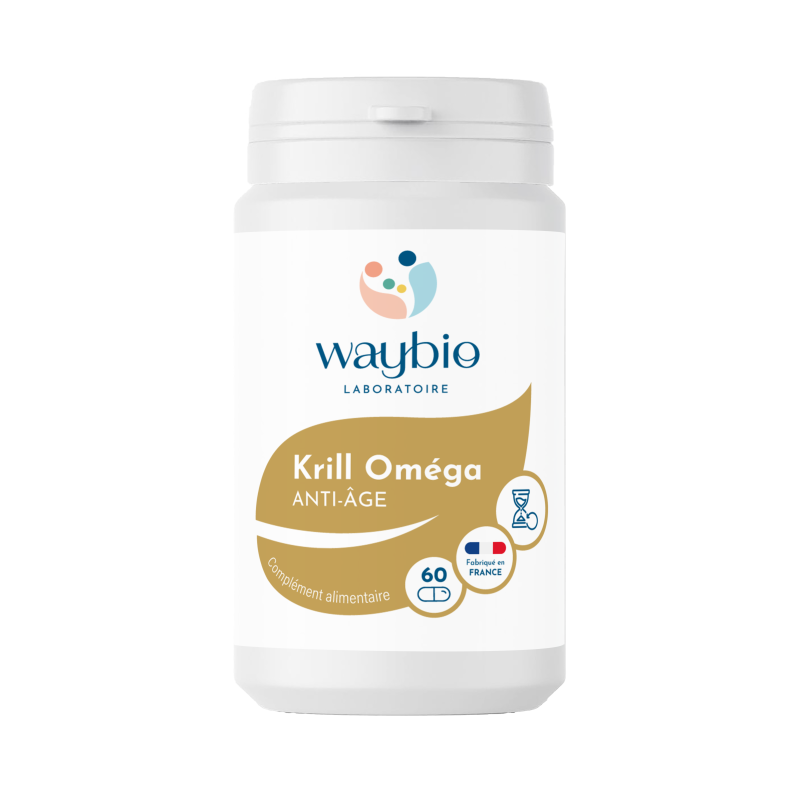
Krill Omega brings together several constituents naturally present in a single marine matrix. At a dose of four capsules, it provides 2,000 mg of krill lipid extract from the pure waters of Antarctica.
This extract notably provides:
EPA and DHA: the main active ingredients for heart support
EPA and DHA are two long-chain omega-3s found in marine foods. Once absorbed, they notably become part of the membranes surrounding cells. They also contribute to producing lipid messengers involved in the function of the cardiovascular system.
The combination of EPA and DHA contributes to normal heart function. This effect is recognised from a daily intake of 250 mg of EPA and DHA. With 408 mg provided by four capsules, the formula alone supplies an amount above this reference level. DHA also has an important structural role in membranes, notably in the brain and retina.
Phospholipids and phosphatidylcholine: a distinctive lipid matrix
The formula provides 800 mg of phospholipids, including 600 mg of phosphatidylcholine. Phospholipids are molecules capable of interacting with both water and fats. This property enables them to contribute to cell-membrane structure and lipid transport in the body.
In krill oils, some omega-3s are generally associated with phospholipids, whereas standard fish oils often provide them as triglycerides or ethyl esters. This organisation is an interesting form of supply for lipid dispersion and incorporation.
Phosphatidylcholine is the main phospholipid in this formula. It helps form cell membranes and also acts as a choline reserve. Its presence therefore strengthens the coherence between omega-3 intake, membrane organisation and fat metabolism.
Choline: fat metabolism and liver function
Four capsules provide 100 mg of natural choline. The body uses choline to make phosphatidylcholine and maintain membrane structure. It is also involved in the work of the liver, which must process, package and transport fats.
Choline contributes to:
-
normal lipid metabolism;
-
the maintenance of normal liver function;
-
normal homocysteine metabolism, an intermediate molecule derived from protein metabolism.
European conditions for using these claims require at least 82.5 mg of choline per serving. The amount provided by four capsules therefore reaches this threshold.
Astaxanthin: a characteristic constituent of krill
Astaxanthin is a red-orange carotenoid from the marine food chain. It contributes to the characteristic colour of krill and its oil. As a fat-soluble compound, it naturally accompanies the phospholipids and fatty acids in the extract. Our formula provides 200 µg, or 0.2 mg.
Who is this product for?
Krill Omega may notably be suitable for:
-
people who eat little oily fish or other marine sources of EPA and DHA;
-
people wishing to support normal heart function through a sufficient daily intake of EPA and DHA;
-
people looking for omega-3s associated with a phospholipid-rich matrix;
-
people wishing to support their fat metabolism and normal liver function through choline;
-
people who prefer a formula combining omega-3s, phosphatidylcholine, choline and astaxanthin in a single marine extract.
Ingredient synergy
EPA and DHA are mainly responsible for supporting heart function. Phospholipids, and phosphatidylcholine in particular, form a matrix capable of carrying and transporting fatty acids. They also contribute to building the membranes into which omega-3s can be incorporated.
Choline completes this combination by supporting lipid metabolism and normal liver function. Astaxanthin naturally accompanies this marine matrix and gives it its characteristic colour.
What does the science say?
A clinical study involving 300 adults
Published in 2014, this American study aimed to assess the influence of krill-oil supplementation on blood triglycerides and the incorporation of EPA and DHA into red blood cells.
The researchers recruited 300 men and women aged 21 to 79 who ate little oily fish and had triglycerides between 150 and 499 mg/dL. The trial was conducted at two clinical centres in the United States, in North Dakota and Missouri.
For 12 weeks, participants received, double-blind:
-
a placebo made with olive oil;
-
or 0.5 g, 1 g, 2 g or 4 g of krill oil per day.
These doses respectively provided approximately 100, 200, 400 or 800 mg of EPA and DHA. The group receiving 2 g of krill oil therefore studied an amount of extract and omega-3s close to the maximum dose of our Waybio product, which provides 2 g of extract and 408 mg of EPA and DHA.
After combining the four doses and measurements taken at 6 and 12 weeks, the researchers calculated a 10.2% reduction in triglycerides compared with placebo. LDL cholesterol did not increase compared with the control group.
The omega-3 index, which measures the proportion of EPA and DHA in red blood-cell membranes, had increased by 29% after 12 weeks in the group receiving 2 g of krill oil, compared with a 3% decrease with placebo. This result shows that the omega-3s from the oil studied were successfully absorbed and then incorporated into cell membranes.
Reference: Berge K, Musa-Veloso K, Harwood M, Hoem N, Burri L. Krill oil supplementation lowers serum triglycerides without increasing low-density lipoprotein cholesterol in adults with borderline high or high triglyceride levels. Nutrition Research. 2014;34(2):126-133. DOI: 10.1016/j.nutres.2013.12.003 — PubMed





 Anti-aging
.png) Expertise based on experience and science
Expertise based on experience and science.png) Certified products
Certified products The best of nature