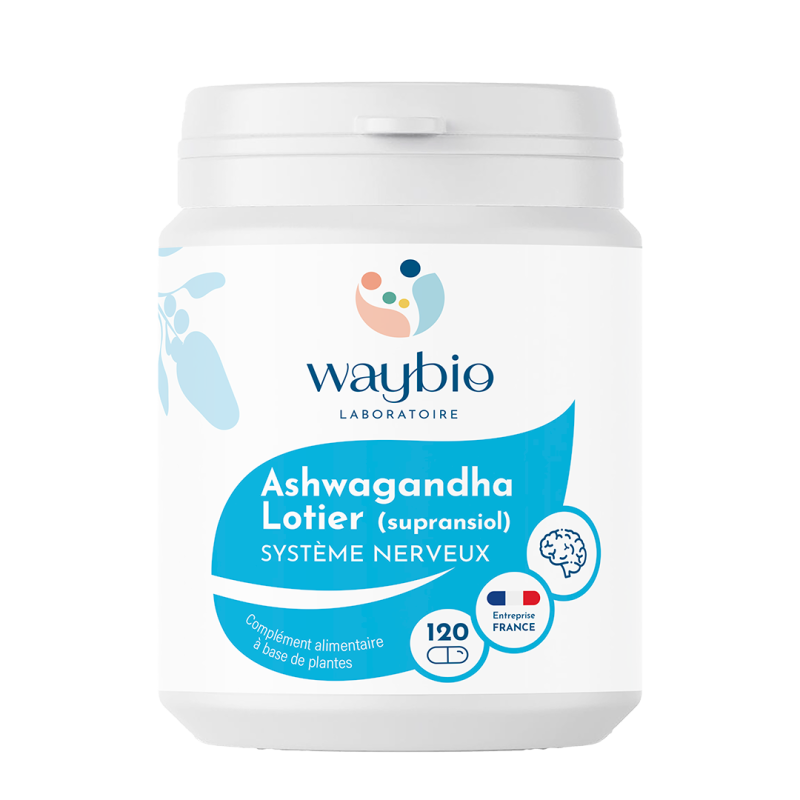
Ashwagandha brings together
three complementary plant preparations. The maximum daily dose of
four capsules provides
900 mg of ashwagandha root powder, 540 mg of ashwagandha root extract and 360 mg of the aerial parts of bird’s-foot trefoil.
Ashwagandha for better adaptation during periods of tensionAshwagandha, or
Withania somnifera, is a shrub in the Solanaceae family. Nicknamed
“Indian ginseng”, although it does not belong to the genus
Panax, it holds an important place in the
Ayurvedic tradition. Its root is notably used there as a
rasayana, a category of preparations intended to
support the body’s resilience and vitality.
When faced with a stressful situation, the brain rapidly activates several adaptive systems. One of the main ones connects the
hypothalamus, pituitary gland and adrenal glands. This communication chain triggers the release of
cortisol. In the short term, this hormone is useful: it mobilises energy, increases alertness and prepares the body to respond. However, when demands are repeated, returning to a calm state can become more difficult. This may result in a
feeling of persistent tension, increased irritability, less restorative sleep or digestion that is more sensitive to emotions.
Ashwagandha is described as an
adaptogen because it helps the body
adjust its response to pressures rather than causing abrupt stimulation or simple drowsiness. Its role is mainly associated with
modulating the stress response and cortisol. It therefore supports the ability to maintain greater perspective and a
more stable emotional state during demanding periods.
Certain constituents of the root also act on pathways related to
GABA, a nerve messenger that limits excessive neuronal excitation and facilitates a return to a calmer state. The root notably contains
withanolides, a family of steroidal lactones naturally present in the plant, as well as other plant compounds.
A dual form: root powder and extractThe formula provides a total of
1,440 mg of two ashwagandha preparations per four capsules:
•
900 mg of root powder;
•
540 mg of root extract.
The powder is obtained by
drying and then grinding the root. An extract is obtained by bringing the plant into contact with a solvent and then concentrating the extracted substances. It therefore makes it possible to bring together more of certain compounds in a smaller volume.
The value of this dual presentation therefore lies in
galenic complementarity: the
powder provides the root’s overall matrix, while the
extract provides a concentrated fraction.
Bird’s-foot trefoil, a traditional calming complementBird’s-foot trefoil,
Lotus corniculatus, is a plant in the Fabaceae family that is widespread throughout temperate regions of Eurasia. Its fan-shaped pods resemble small horns, which is the origin of its name. The formula uses its aerial parts at a dose of
360 mg per four capsules. The aerial parts of bird’s-foot trefoil contain various
flavonoids, saponins and tannins, including proanthocyanidins.
Above all, bird’s-foot trefoil has a history of traditional use in preparations intended to
calm nervousness and promote relaxation. It therefore complements ashwagandha with a plant-based approach more focused on
calming.
Stress and the digestive system also maintain a
constant dialogue. Signals travel in both directions through the nervous system, notably the
vagus nerve, hormones and the immune system. A period of tension can therefore alter digestive motility or make the intestine more sensitive.
Bird’s-foot trefoil contributes to
intestinal balance by promoting the development of beneficial microflora.
The formula’s strengths •
1,440 mg of two ashwagandha root preparations per four capsules;
•
combination of a powder and a root extract;
•
360 mg of the aerial parts of bird’s-foot trefoil;
• an approach focused on
adapting to stress and returning to calm;
• formula in
vegetable capsules;
• product suitable for a
vegetarian and vegan diet;
•
adjustable dosage of one to four capsules per day.
Who is this product for?This formula may be particularly suitable for:
• adults going through a period of
professional, family or personal pressure;
• people who feel
mentally strained and find it difficult to release tension at the end of the day;
• adults seeking an
adaptogenic plant to support their emotional balance;
• people whose
digestive comfort seems sensitive to periods of stress, as part of a comprehensive and measured approach;
•
vegetarian or vegan people looking for a supplement in vegetable capsules.
What does the science say?In
2019, an Indian team sought to determine whether an
ashwagandha root extract could support adults with a
high level of perceived stress.
The trial was conducted at
Risk Care Hospital in Thane, Maharashtra, India. It included
60 healthy men and women aged 18 to 55 with a score above 20 on the PSS Perceived Stress Scale. A total of
58 participants completed the eight weeks of follow-up.
The volunteers were randomly divided into three groups:
•
125 mg of KSM-66 aqueous root extract twice a day, or 250 mg per day;
•
300 mg of the same extract twice a day, or 600 mg per day;
• an
identical-looking starch placebo, taken twice a day.
The capsules were consumed
after meals with water or milk. Neither participants nor researchers knew which product each person had been assigned until the end of the trial.
After eight weeks, the average perceived stress score in the group receiving 600 mg per day fell from
22.95 to 14.15, compared with a change from
22.70 to 16.63 in the placebo group. The difference between the groups was
statistically significant, with a
p value below 0.001.
In the same group, the average blood cortisol concentration fell from
16.12 to 10.86 µg/dL, a decrease of approximately 32.6%. In the placebo group, it fell from 16.15 to 15.52 µg/dL. The observed difference for cortisol was also significant, with a
p value below 0.0001.
Sleep quality also improved compared with placebo.
These results show that a
specific aqueous ashwagandha root extract can support the
reduction of perceived stress and regulation of cortisol in stressed adults.
Full reference: Salve J, Pate S, Debnath K, Langade D. “Adaptogenic and Anxiolytic Effects of Ashwagandha Root Extract in Healthy Adults: A Double-blind, Randomized, Placebo-controlled Clinical Study.”
Cureus. 2019;11(12).
DOI 10.7759/cureus.6466 –
PubMed PMID 32021735.





 Nervous system
.png) Expertise based on experience and science
Expertise based on experience and science.png) Certified products
Certified products The best of nature