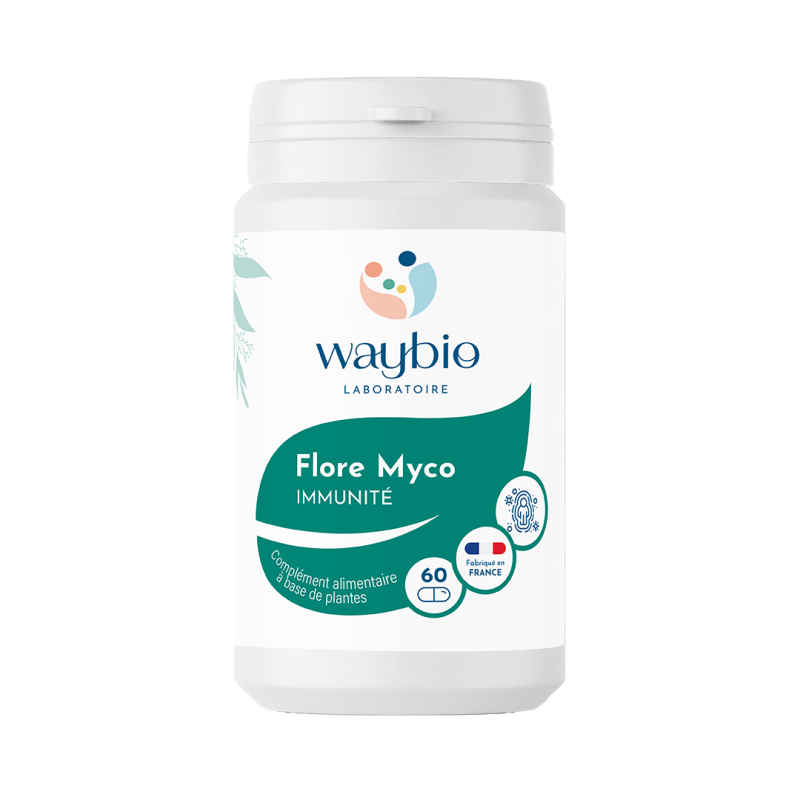
Flore Myco offers a
30-day oral formula based on three complementary lines:
the supply of lactobacilli, the maintenance of normal mucous membranes through vitamin B2, and plant support provided by andrographis and grapefruit seed.
Two capsules provide
10 billion colony-forming units, or CFU, divided among eight strains of lactobacilli. They also provide
200 mg of andrographis powder, 200 mg of grapefruit seed extract and 1.4 mg of vitamin B2, or
100% of the nutrient reference value.
Why are lactobacilli important?The
vaginal microbiota is an ecosystem composed of microorganisms living in contact with the mucous membrane. In many women, it is predominantly represented by
lactobacilli, notably certain strains belonging to the species
Lactobacillus crispatus and Lactobacillus gasseri.
When these bacteria use the resources available in the vaginal environment, they notably produce
lactic acid. This contributes to maintaining a
naturally acidic environment, often between 3.5 and 4.5 in women of reproductive age. This acidity limits excessive multiplication of many microorganisms less suited to this environment.
Depending on the strain, lactobacilli can also:
•
occupy adhesion sites on the mucous membrane;
•
compete with other microorganisms for nutrients;
• produce substances such as
bacteriocins or surface molecules;
• communicate with mucosal cells and
contribute to its balance.
Eight strains with complementary profilesThe formula combines
seven species of lactobacilli.
Lactobacillus rhamnosus is present as two distinct strains, bringing the total to
eight strains.
•
Lactobacillus crispatus is one of the species frequently associated with a vaginal microbiota dominated by lactobacilli. Certain strains produce both D- and L-lactic acid and have a good capacity to interact with the vaginal epithelium.
•
Lactobacillus gasseri is also a frequent natural inhabitant of the vaginal ecosystem. Specifically selected strains have shown their ability to produce lactic acid and, in some cases, to be detected in the vagina after oral administration.
•
Lactobacillus rhamnosus, present here as two strains, is widely used in microbiotic supplements. Certain well-characterised strains are able to withstand digestive transit and have been studied for their value to the urogenital ecosystem.
•
Lactobacillus fermentum includes strains that produce lactic acid and can interact with different biological environments.
•
Lactobacillus casei and
Lactobacillus paracasei are two closely related species. They are included in microbiotic blends for their fermentative capacities and ability to survive digestive transit.
•
Lactobacillus plantarum is a lactic acid bacterium known for its ability to adapt to different environments. It produces lactic acid, surface molecules and bacteriocins.
The value of the blend therefore lies in providing
several microbiological profiles.
An oral formula dosed at 10 billion CFUA
CFU corresponds to a living bacterium, or group of bacteria, capable of forming a colony under specified culture conditions. This unit therefore indicates
microbiological viability, not the weight of the complex.
Probiotic preparations are generally produced through
controlled fermentation, then concentrated and often
freeze-dried to keep the microorganisms stable until consumption.
Vitamin B2: maintenance of mucous membranesVitamin B2, or riboflavin, is converted in the body into cofactors called
FMN and FAD. These contribute to many reactions needed for energy production and cellular function.
The tissues forming mucous membranes are regularly renewed. An appropriate nutritional intake helps preserve their structure and normal function. In accordance with claims authorised in Europe, vitamin B2 contributes to:
• the
maintenance of normal mucous membranes;
• the
maintenance of normal skin;
•
normal energy-yielding metabolism;
• the
protection of cells against oxidative stress;
• the
reduction of tiredness and fatigue.
Flore Myco provides
1.4 mg per day, or 100% of the nutrient reference value. This vitamin supports the tissue on which the microbiota develops, notably the
vaginal mucous membrane.
Andrographis: support for natural defencesAndrographis paniculata is a very bitter plant native to South Asia and widely used in Indian, Chinese and Southeast Asian traditions. Its most studied constituents are
diterpene lactones, including andrographolide.
These compounds can influence various signals involved in the immune response. In Flore Myco, andrographis complements the microbiota–mucous membrane axis with
general support for natural defences, notably during periods of variations associated with the cycle or menopause.
Grapefruit seed extract: a plant-based co-activeGrapefruit,
Citrus × paradisi, belongs to the citrus family. Its seeds contain different families of plant compounds, notably
limonoids, while other parts of the fruit provide flavonoids.
Grapefruit seed extract is included in the formula as a co-active designed to
support microbial balance.
What distinguishes the formulaIntimate Flora combines:
•
eight strains of lactobacilli for a total of 10 billion CFU;
• two species,
L. crispatus and L. gasseri, frequently found in the vaginal ecosystem;
• a dose of
vitamin B2 covering 100% of the nutrient reference value;
•
two complementary plant ingredients;
• a presentation in
vegetable capsules;
• a
simple 30-day programme.
Who is this product for?Intimate Flora may be particularly suitable for:
• adult women wishing to
maintain their intimate balance;
• women looking for a
diverse intake of lactobacilli;
• during periods when the
intimate ecosystem seems more fragile;
• women sensitive to
variations associated with the menstrual cycle;
• women wishing to support their
intimate balance during menopause;
• people looking for a formula combining
microbiota and nutritional maintenance of mucous membranes;
• those who prefer a
one-month oral course in vegetable capsules.
What does the science say?A
recent study published in 2025 sought to determine whether
orally administered lactobacilli could be found in the vaginal microbiota.
This
randomised, double-blind, placebo-controlled trial at the Hospital del Mar Research Institute in Barcelona, Spain, took place between February and June 2023.
The researchers recruited
48 healthy premenopausal women aged 18 to 45 without an active vaginal infection.
Forty-six participants were included in the final analysis.
They were divided into three groups:
•
1 billion CFU per day of Lactobacillus gasseri CECT 30648;
•
1 billion CFU of L. gasseri CECT 30648 combined with 500 million CFU of Lactobacillus crispatus CECT 30647;
• a
placebo capsule.
The capsules were taken daily between two menstrual periods for a maximum of
18 days. Vaginal samples were taken every three days. The main objective was to look for the administered strains using a
genetic method capable of distinguishing them from other lactobacilli.
At the end of the trial,
L. gasseri CECT 30648 had been detected at least once in
19 of the 34 participants who received a probiotic, or 55.9%, compared with
one participant out of 12 in the placebo group, or 8.3%. The difference was statistically significant:
p = 0.005.
The total proportion of genera other than lactobacilli had also decreased in the probiotic groups compared with the start of the intervention, with
p = 0.047. A shift towards communities more dominated by lactobacilli was observed, with
p = 0.039.
Intimate Flora provides
1.25 billion CFU of L. gasseri per day.
Full reference: Perez M, Armengol E, Del Casale A, Campedelli I, Aldea-Perona A, Pérez Otero M, Rodriguez-Palmero M, Espadaler-Mazo J, Huedo P.
Lactobacillus gasseri CECT 30648 shows probiotic characteristics and colonizes the vagina of healthy women after oral administration. Microbiology Spectrum. 2025;13(9).
DOI 10.1128/spectrum.00211-25 —
PubMed.





 Immunity
.png) Expertise based on experience and science
Expertise based on experience and science.png) Certified products
Certified products The best of nature