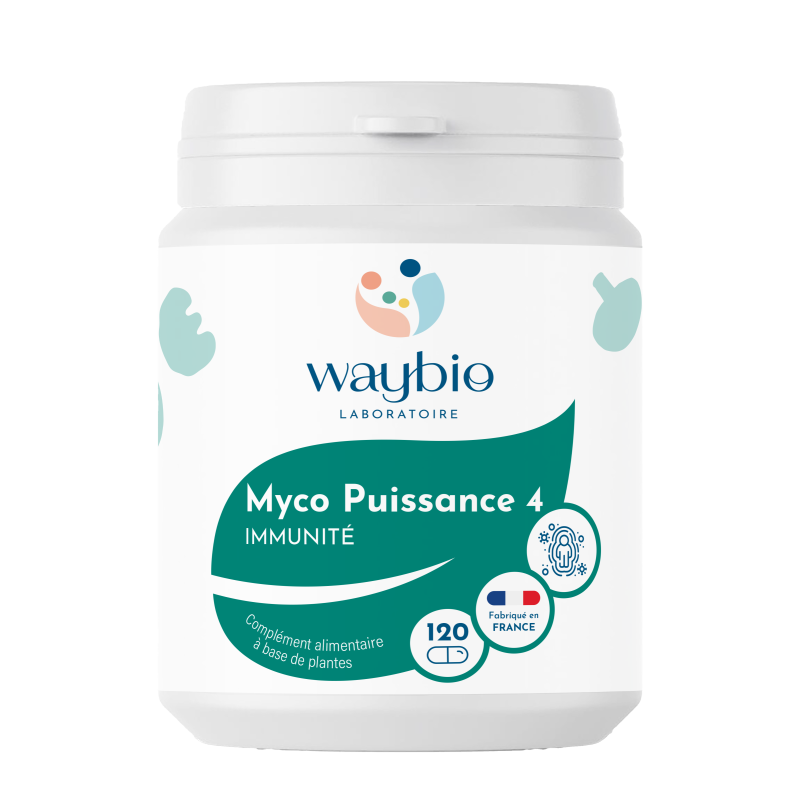
Myco Puissance 4 provides a daily total of
885 mg of mushrooms —
chaga, reishi, shiitake, maitake, cordyceps and agaricus blazei — together with
15 mg of zinc as bisglycinate, or
150% of the nutrient reference value.
The formula works along
two complementary lines. Zinc provides precisely established nutritional support for the
function of the immune system. The six mushrooms enrich the preparation with various families of
polysaccharides and other compounds naturally present in mushrooms.
Zinc, the formula’s central supportZinc is a trace element essential to hundreds of reactions in the body. It is notably involved in
protein and DNA synthesis as well as
cell renewal. These functions are important for immune cells, which need to form, communicate and multiply rapidly when the body requires them.
Zinc also contributes to the proper function of immediate immune cells, such as
macrophages and cells responsible for recognising foreign elements. It also supports the activity of
lymphocytes, which are responsible for more targeted immune responses.
At
15 mg per day, Myco Puissance 4 qualifies for the authorised European claims that zinc:
• contributes to the
normal function of the immune system;
• contributes to
protecting cells against oxidative stress;
• has a role in the
process of cell division.
Oxidative stress is an imbalance between the production of reactive molecules and the means available to cells to neutralise them. By contributing to
antioxidant protection systems, zinc helps preserve cellular structures during periods when the body is under greater strain.
Here, zinc is used in
bisglycinate form, a chelated form in which the mineral is bound to two glycine molecules. This form is associated with
higher bioavailability and
better digestive tolerance compared with zinc gluconate.
Six mushrooms with complementary profilesMushroom cell walls are naturally composed of
polysaccharides, including beta-glucans. These molecules are not digested like ordinary sugars. They can reach the intestine and come into contact with the
microbiota and immune cells present in the digestive mucosa.
Certain cells, such as
macrophages and dendritic cells, have receptors capable of recognising the structure of beta-glucans. This recognition contributes to the signals that organise
immediate immunity and its communication with lymphocytes.
Chaga – 210 mgChaga, or
Inonotus obliquus, is the
most highly dosed mushroom in the formula. It grows mainly on birch trees in cold regions and has a long-standing place in Northern European and Russian traditions.
Its matrix notably contains
polysaccharides, phenolic compounds, pigments and various triterpenoids. These constituents are mainly studied for their interactions with
antioxidant mechanisms and cellular response.
Reishi – 165 mgReishi, or
Ganoderma lucidum, is also called
lingzhi in China. This Asian mushroom, traditionally used for more than two millennia, grows on wood or at the base of certain trees.
It contains various families of
polysaccharides as well as
triterpenoids characteristic of the genus
Ganoderma. Polysaccharides are particularly studied for their ability to communicate with immediate immune cells. Reishi is one of the mushrooms most renowned for
supporting the body’s natural defences.
Shiitake – 150 mgShiitake, or
Lentinula edodes, is an edible mushroom native to East Asia and traditionally cultivated on wood. Its cell wall contains
beta-glucans whose structure varies according to the strain, the part of the mushroom and the processing method.
One of its best-known polysaccharides is
lentinan. Here, shiitake provides a mushroom matrix complementary to those of reishi and maitake.
Maitake – 120 mgMaitake, or
Grifola frondosa, is an edible mushroom that grows in clusters at the base of trees. It is known as maitake in Japan and as
“hen of the woods” in the West.
Its fruiting bodies and mycelium may contain several
beta-glucans and complexes combining polysaccharides and proteins. Certain concentrated preparations are referred to as
“D-fraction” or “MD-fraction”.
Cordyceps – 120 mgThe term
cordyceps refers to several mushroom species. The best known are
Ophiocordyceps sinensis and Cordyceps militaris. They can provide polysaccharides and various nucleosides, the nature of which depends greatly on the species and cultivation conditions.
Since wild cordyceps is rare, commercial preparations are generally obtained from
cultivated mycelium or fermentation.
Agaricus blazei – 120 mgAgaricus blazei, also called the
“sun mushroom”, is an edible mushroom of Brazilian origin. It is particularly studied for its
polysaccharides, notably beta-glucans.
These polysaccharides can interact with immediate immune cells and contribute to exchanges between different branches of the immune system. Agaricus contributes to
strengthening the body’s natural defences and supports proper immune-system function.
The distinctive features of Myco Puissance 4 •
Six mushrooms combined in one formula.
•
885 mg of mushroom material per daily dose.
•
15 mg of zinc, or 150% of the NRV.
•
Zinc in bisglycinate form.
•
Dosage divided between morning, midday and evening.
•
120 pullulan vegetable capsules.
• Formula stated to be suitable for a
vegetarian and vegan diet.
• One bottle corresponding to
40 days of use.
Who is this product for?Myco Puissance 4 may be particularly suitable for:
• adults wishing to support the
normal function of their immune system;
• during
seasonal changes or periods when the body is under greater strain;
• people whose
dietary zinc intake is low or variable;
• people following a
predominantly plant-based diet, in which zinc absorption may be reduced by certain phytates;
• consumers looking for a
vegan formula combining several mushrooms;
• people who prefer to divide their supplementation between the
three main meals.
Ingredient synergyThe combination is based on the complementarity between
zinc and polysaccharides naturally present in mushrooms.
Zinc is the ingredient mainly responsible for the officially recognised immune benefit. It acts within immune cells:
renewal, communication, protein synthesis, cell division and protection against oxidative stress.
Fungal beta-glucans, when present in sufficient quantity and with an appropriate structure, instead act as signals recognised by receptors located on certain immediate immune cells. Their main site of interaction after ingestion may be in the
immune tissues associated with the intestine.
What does the science say?Clinical research from the
European ZENITH programme examined the effect of zinc supplementation on various
immune markers in healthy adults.
Published in
2007, it was mainly conducted at the
Northern Ireland Centre for Food and Health at Ulster University in Northern Ireland. It followed
93 men and women aged 55 to 70, with an average age of 62.4.
Participants were divided
randomly and double-blind into three groups:
•
31 people received a placebo;
•
28 people received 15 mg of zinc per day;
•
34 people received 30 mg of zinc per day.
Zinc was provided in
gluconate form, whereas we use
bisglycinate, which has higher bioavailability than the form in the study. Supplementation lasted
six months. The researchers examined different lymphocyte populations and several markers of their activation.
At the start of the research,
better zinc status was associated with higher numbers of certain lymphocyte populations and better T-cell activation.
After six months, the dose of
15 mg of zinc per day, identical to the elemental amount provided by Myco Puissance 4, resulted in a
statistically significant increase in the ratio of CD4 to CD8 T lymphocytes. CD4 cells coordinate part of the immune response, while CD8 cells contribute to eliminating abnormal or infected cells. Their ratio is a marker of the balance between different immune functions.
The results therefore primarily show
the importance of adequate zinc status for immune-cell balance.
Reference: Hodkinson CF, Kelly M, Alexander HD, Bradbury I, Robson PJ, Bonham MP, O’Connor JM, Coudray C, Strain JJ, Wallace JMW.
Effect of Zinc Supplementation on the Immune Status of Healthy Older Individuals Aged 55–70 Years: The ZENITH Study.
The Journals of Gerontology: Series A. 2007;62(6):598-608.
DOI: 10.1093/gerona/62.6.598 –
PubMed.





 Immunity
.png) Expertise based on experience and science
Expertise based on experience and science.png) Certified products
Certified products The best of nature