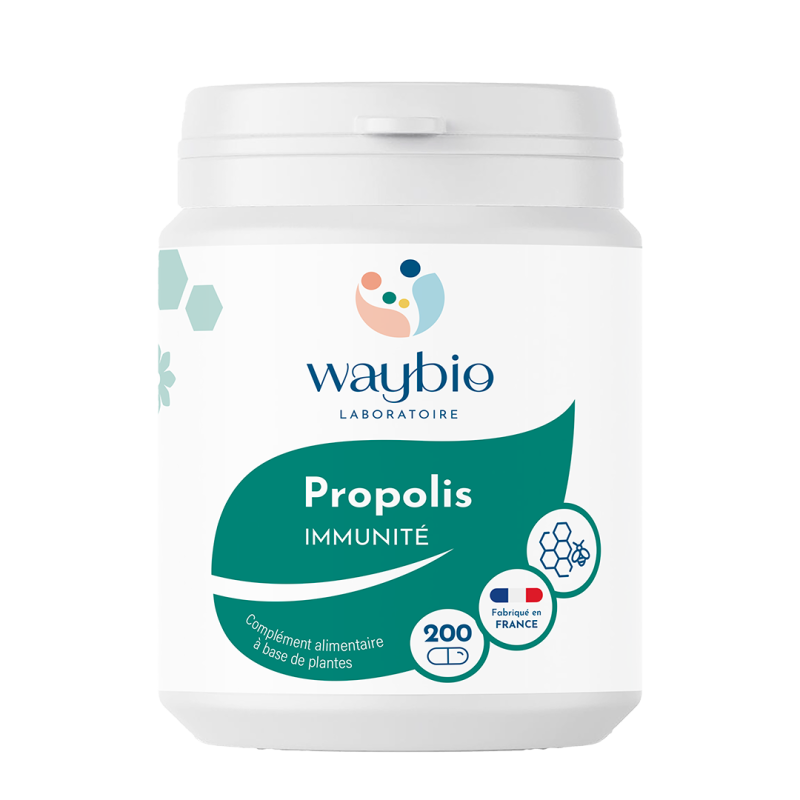
Propolis offers a
single-active-ingredient formula providing a
propolis extract certified organic by Ecocert. The maximum recommended intake, namely
six capsules per day, provides
1,440 mg of extract.
This presentation makes it possible to include propolis in a
33-day daily supplementation programme. Unlike an oral spray, the capsules are not intended to act through direct contact with the throat: they provide propolis
orally as part of an overall approach to supporting the body.
The hive’s protective substancePropolis is a resinous material made by bees from substances collected from the
buds, bark and exudates of various plants. The bees then mix them with wax and their own secretions before using them in the hive.
They notably use propolis to:
•
seal small openings;
•
reinforce certain parts of the hive;
•
coat interior surfaces;
•
limit the growth of microorganisms in their habitat.
Its name comes from the Greek words
pro, meaning “in front of” or “in defence of”, and
polis, meaning city. Propolis can therefore be understood as the substance placed
“before the city” to protect the colony.
Its use by humans is ancient. It was already known in several
ancient civilisations, notably in Egypt and the Greco-Roman world.
The value of an extractRaw propolis contains
resins, wax, aromatic substances and small amounts of pollen. To obtain an extract, it is cleaned and then brought into contact with a solvent that makes it possible to
recover some of its soluble constituents.
Polyphenols involved in antioxidant balancePolyphenols, notably
flavonoids and phenolic acids, are one of the main families of compounds found in many types of propolis.
The body naturally produces reactive oxygen species during energy production, immune activity or physical exertion. When their production exceeds the available regulatory capacity, they can promote
the oxidation of lipids, proteins and other cellular constituents.
The phenolic compounds in propolis can act at several levels:
• they donate an electron or hydrogen atom to
stabilise certain reactive molecules;
• they
limit certain chain reactions responsible for lipid oxidation;
• they contribute to the
regulation of internal antioxidant defences;
• they support the activity of
glutathione and enzymes such as glutathione peroxidase.
Certain flavonoids also act on the
Nrf2 pathway, a signalling system that controls the production of several protective enzymes. This action is therefore not based solely on directly neutralising oxidising molecules: it can also support the
mechanisms cells use to preserve their balance.
Support for natural defencesThe immune response relies on a sequence of steps:
detecting a foreign element, activating defence cells, communication between these cells and then a gradual return to balance.
Propolis compounds can interact with several participants in this response, including
macrophages, dendritic cells and certain cells responsible for immune surveillance. They also influence the production of
cytokines, the messengers used by cells to coordinate their actions.
Polyphenols can notably modulate
NF-κB, a signalling pathway involved in triggering and determining the intensity of the inflammatory response. Their value therefore lies in supporting an
appropriate response: sufficiently active to ensure the body’s surveillance, but properly regulated over time.
This action helps explain the
traditional use of propolis during seasonal changes and periods when natural defences are under greater strain.
Particular value during seasonal periodsThe
mucous membranes of the respiratory tract are a first point of contact with the outside air. They have physical and immune protective mechanisms designed to recognise and eliminate unwanted elements.
The phenolic compounds in propolis can support
communication between immune cells and the management of oxidative reactions associated with their activation. Some may also disrupt the membranes, adhesion or certain enzymes of microorganisms in experimental models.
With this capsule formula, the aim is a
regular oral intake. It can therefore support the body during
autumn, winter, seasonal changes or periods spent in group settings.
Who is this product for?Propolis may be particularly suitable for:
• people wishing to
include propolis in their daily routine;
• during
seasonal changes, particularly in autumn and winter;
• during periods when
natural defences are under greater strain;
• people seeking an intake of
naturally occurring phenolic compounds;
• those who prefer an
organic single-active-ingredient formula;
• people who favour
capsules over local application as a spray.
These profiles remain subject to precautions regarding
allergies to pollen and bee products, asthma and atopic conditions.
What does the science say?A
clinical study published in 2019 assessed the influence of oral propolis supplementation on the body’s
antioxidant defences.
This
randomised, double-blind, placebo-controlled trial in Iran included
62 adults aged 30 to 55 with type 2 diabetes. Participants were divided into two groups of 31 people.
For
eight weeks:
• the first group received
500 mg of propolis three times a day, or 1,500 mg daily;
• the second group followed the same intake schedule with a
placebo.
The researchers notably measured the
total antioxidant capacity of the blood and the activity of two protective enzymes:
glutathione peroxidase and superoxide dismutase.
After eight weeks, compared with placebo, propolis led to:
• a
significant increase in total antioxidant capacity;
• a
significant increase in glutathione peroxidase activity;
• a
significant increase in superoxide dismutase activity.
All three results had a value of
p < 0.05. Improvements in several glycaemic parameters were also observed, but these specifically concern the diabetic population studied and are not a benefit to be attributed to this supplement.
The tested dose,
1,500 mg per day, is close to the
1,440 mg provided by six Waybio capsules.
The trial therefore allows the conclusion that
oral propolis supplementation supported several markers of antioxidant defences in these participants over eight weeks.
Full reference: Afsharpour F, Javadi M, Hashemipour S, Koushan Y, Haghighian HK.
Propolis supplementation improves glycemic and antioxidant status in patients with type 2 diabetes: A randomized, double-blind, placebo-controlled study. Complementary Therapies in Medicine. 2019;43:283-288.
DOI: 10.1016/j.ctim.2019.03.001 —
PubMed.





 Immunity
.png) Expertise based on experience and science
Expertise based on experience and science.png) Certified products
Certified products The best of nature