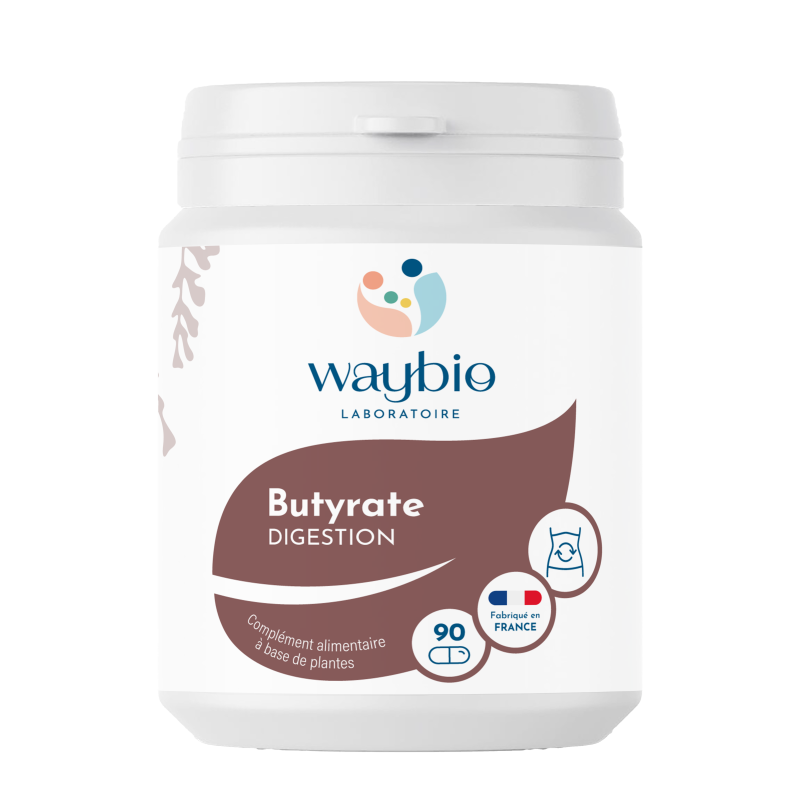
Butyrate offers a different approach from probiotics and prebiotics. Our formula provides
neither live bacteria nor fibres among the declared active ingredients: it directly supplies
butyrate, a molecule normally produced in the colon when intestinal bacteria ferment dietary fibre.
The daily dose of
three capsules contains
600 mg of microencapsulated calcium butyrate, precisely providing
210 mg of butyric acid and 42 mg of calcium. It is complemented by
150 mg of skullcap-root extract and
75 mg of L-threonine.
Butyrate: a natural metabolite of the microbiota Butyrate is a short-chain fatty acid containing four carbon atoms. Its name comes from the Latin
butyrum, meaning “butter”, the food in which butyric acid was historically identified. In the body, however, its main origin is intestinal: certain bacteria in the colon convert
fermentable fibres into acetate, propionate and butyrate.
ANSES notes that most of these
short-chain fatty acids are absorbed by the colon mucosa and that butyrate is then used by intestinal cells. Direct intake is particularly consistent when the diet is temporarily low in fibre or when seeking
targeted support without using live microorganisms.
A preferred energy source for colon cells The cells lining the colon, called
colonocytes, readily use
butyrate as fuel. After entering these cells, it is converted in their mitochondria to produce the energy needed for their function, renewal and maintenance of the mucosa.
This local use distinguishes butyrate from many other nutrients: it is not used solely as a general energy reserve, but acts directly in the
intestinal tissue that absorbs it. Regular intake therefore supports the
energy needs of the cells responsible for preserving the organisation of the colon wall.
Support for the intestinal barrier The intestinal wall must allow useful nutrients to pass through while limiting the passage of unwanted substances. To perform this function, epithelial cells are connected by
tight junctions, comparable to sealing systems placed between two neighbouring cells.
Butyrate contributes to the
proper assembly of these junctions and the maintenance of their function. It is notably involved in activating
AMPK, an enzyme that helps the cell adapt its activity to its energy needs. This mechanism supports the organisation of the barrier and helps maintain an
effective separation between intestinal contents and the tissues beneath the mucosa.
A messenger for intestinal balance Butyrate does not only play an energy role. It also acts as a
signalling molecule. It can activate several receptors on the surface of intestinal and immune cells, including
FFAR2, FFAR3 and HCAR2. It also influences certain enzymes that control how cells use their genes.
Through these various pathways, butyrate contributes to the
balance of chemical messages exchanged within the mucosa. It supports communication between the
epithelium, microbiota and local immune cells, while supporting the normal processes of intestinal-tissue renewal and protection.
ButiShield™: a sodium-free microencapsulated form Butyrate naturally has a strong odour and may be released too early in the digestive system when used in an unprotected form. Butyrate therefore uses
ButiShield™, a
microencapsulated calcium butyrate.
MicroPEARLS™ technology is based on a spray-freezing process. Microencapsulation is designed to
reduce butyrate’s characteristic odour and allow a
more gradual release in the digestive tract. The
gastro-resistant plant-based capsules provide additional protection against stomach acidity.
The calcium form also supplies butyrate
without using its sodium salt. Its documented distinguishing value therefore concerns the
absence of sodium intake, ease of use and delayed release.
L-threonine to support the mucus layer L-threonine is an essential amino acid: the body cannot produce it in sufficient quantities and must obtain it from food. It is part of the structure of numerous proteins, including
mucins.
Produced by specialised intestinal cells, mucins form a
protective gel on the surface of the epithelium. This layer helps intestinal contents move smoothly and maintains a distance between the wall and microorganisms present in the intestinal lumen. Threonine is particularly abundant in these proteins and is therefore one of their building materials.
The
75 mg in the daily dose provides a targeted intake at the heart of our formula. Threonine is involved in the
synthesis of mucins, proteins essential to the composition of mucus, and therefore fully aligns with the formula’s functional rationale.
On an industrial scale,
L-threonine is obtained through microbial fermentation.
Skullcap: plant-based support Butyrate provides
150 mg of skullcap-root extract. Certain species, particularly
Scutellaria baicalensis, have a long history of use in Asia under the name Huang-Qin. Their roots notably contain
flavones such as baicalin, baicalein and wogonin, studied for their interactions with oxidation mechanisms and signals involved in tissue balance.
In our formula, skullcap complements the central action of butyrate with
plant-based support focused on digestive comfort.
The role of calcium The
42 mg of calcium represents 5.3% of the nutrient reference value. In Butyrate, calcium is primarily used to form the butyrate salt. This form
stabilises the active ingredient and avoids the use of sodium butyrate. The amount provided remains secondary compared with a supplement specifically intended to increase calcium intake.
Key features •
600 mg of microencapsulated calcium butyrate per day;
•
210 mg of butyric acid;
•
gradual-release ButiShield™ MicroPEARLS™ technology;
•
calcium form without sodium intake;
•
plant-based capsules resistant to stomach acidity;
• combined with
150 mg of skullcap-root extract and 75 mg of L-threonine;
•
no live probiotics or prebiotic fibre among the active ingredients;
•
formula compatible with a vegetarian and vegan diet;
•
90 capsules, providing 30 days of use at the recommended dose.
Who is this product for? Butyrate may be particularly suitable for:
• people wishing to
provide butyrate directly to their intestinal environment;
• people whose diet is temporarily
low in fermentable fibre;
• those wishing to support their
digestive comfort during periods of abdominal sensitivity, bloating or irregular bowel movements;
• people seeking nutritional support for the
mucosa, its mucus layer and its barrier functions;
• those who prefer a
formula without live bacteria;
• people wishing to
avoid the sodium intake associated with sodium butyrate;
•
vegetarians and vegans.
Our formula complements a balanced, fibre-containing diet; it
does not replace the role of fibre in nourishing the microbiota.
What does the science say? A clinical trial on microencapsulated butyrate and abdominal comfort A team of Polish researchers assessed the value of
microencapsulated butyrate in adults with irritable bowel syndrome that persisted despite usual treatment. The trial, conducted in Poland and published in 2013, was
randomised, double-blind and placebo-controlled.
Of 79 people initially allocated to the groups,
66 completed the protocol and were included in the analysis: 34 in the butyrate group and 32 in the placebo group. The participants, including 42 women, were aged
19 to 65 and met the Rome III criteria. Their usual digestive treatments, which they had followed for at least three months, were maintained in both groups.
For
12 weeks, participants received:
• either
300 mg per day of microencapsulated sodium butyrate, in two 150 mg doses;
• or
two placebo capsules of identical size and shape.
Symptoms were assessed at the start of the trial, after four weeks and after twelve weeks. The researchers studied their frequency during the previous week, their intensity and the feeling of adequate relief.
After four weeks,
17.6% of participants in the butyrate group still reported pain during defecation, compared with 59% with placebo, a
statistically significant difference (p = 0.0032).
After twelve weeks, the results were as follows:
| Symptom reported during the previous week |
Butyrate |
Placebo |
p value |
| Spontaneous abdominal pain |
21% |
50% |
0.0132 |
| Pain after meals |
21% |
56% |
0.0031 |
| Pain during defecation |
15% |
59% |
0.0002 |
| Urgency after defecation |
15% |
44% |
0.0100 |
| Change in stool consistency |
18% |
41% |
0.0417 |
| Constipation |
24% |
47% |
0.0493 |
Adequate relief was reported by
32% of the butyrate group compared with 6.25% of the placebo group after four weeks, then by
53% compared with 15.6% after twelve weeks. No adverse effects were reported in either group.
The trial therefore indicates that
microencapsulated butyrate, added to usual treatment, may reduce the frequency of certain discomforts.
Full reference: Banasiewicz T., Krokowicz Ł., Stojcev Z., Kaczmarek B.F., Kaczmarek E., Maik J., Marciniak R., Krokowicz P., Walkowiak J., Drews M.
Microencapsulated sodium butyrate reduces the frequency of abdominal pain in patients with irritable bowel syndrome.
Colorectal Disease. 2013;15(2):204-209. DOI:
10.1111/j.1463-1318.2012.03152.x —
PubMed.





 Digestion
.png) Expertise based on experience and science
Expertise based on experience and science.png) Certified products
Certified products The best of nature