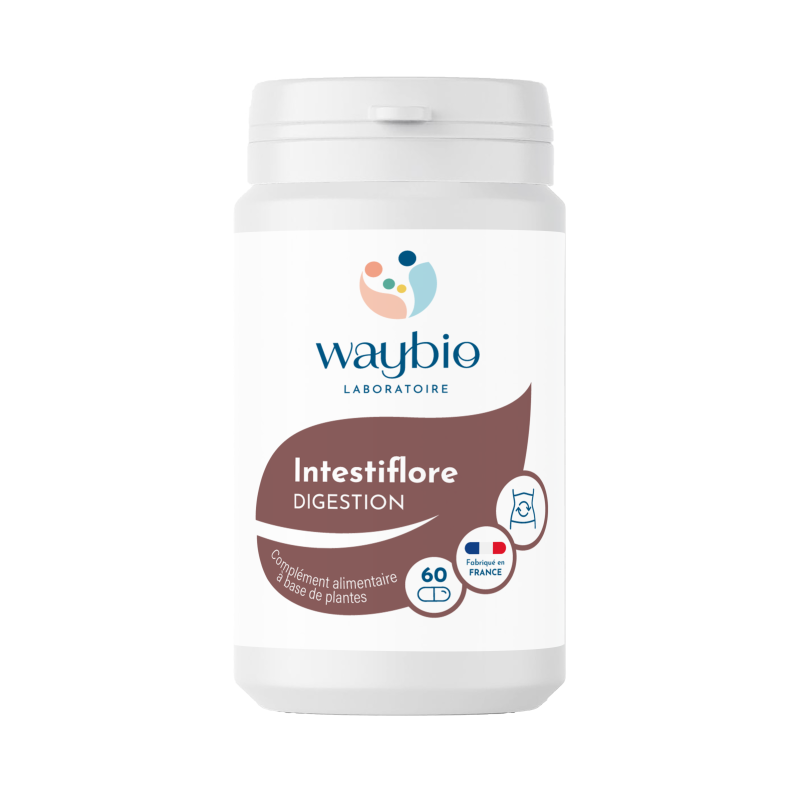
IntestiFlore offers a
comprehensive approach to digestive comfort. In
two capsules, its formula provides
10 billion lactic ferments across ten species,
100 mg of lemon-balm leaf powder,
100 mg of boswellia resin extract—including 65 mg of boswellic acid—as well as
vitamins B2 and B3.
Ten lactic ferments for the intestinal ecosystem The
gut microbiota contributes to the transformation of food residues, the production of numerous metabolites and the constant dialogue between digestive contents and the intestinal mucosa. IntestiFlore combines
six Lactobacillus species, Lactococcus lactis and three Bifidobacterium species.
Lactobacilli and lactococci convert certain carbohydrates into
lactic acid. They can therefore influence the intestinal environment, compete with other microorganisms for nutrients or adhesion sites and communicate with mucosal cells. Bifidobacteria notably produce
lactate and acetate, compounds that may also be used by other members of the microbiota.
The action of these microorganisms is generally
transient: they act mainly while passing through the digestive tract. This particular feature explains the value of
regular consumption during the supplementation period.
Lemon balm: supporting more comfortable digestion The formula contains
100 mg of powdered lemon-balm leaves. Native to a broad area extending from the Mediterranean basin to Central Asia,
Melissa officinalis belongs to the mint family. Its leaves have long been used in European and Mediterranean traditions for
mild digestive complaints, particularly bloating and gas.
Lemon balm naturally contains
aromatic compounds, flavonoids and phenolic acids, including rosmarinic acid. Its digestive value is notably associated with a
soothing action on involuntary contractions of the digestive muscles. It therefore helps during periods marked by
feelings of heaviness, gas or uncomfortable digestion. Leaf powder preserves the plant’s natural spectrum.
Boswellia: a concentrated resin extract IntestiFlore provides
100 mg of boswellia resin extract, including 65 mg of boswellic acid, a concentration of 65%. This high content of marker compounds is one of the formula’s main distinguishing features.
Boswellias are trees whose
aromatic resin, also known as olibanum or frankincense, is traditionally collected after the trunk is cut.
Boswellic acids are triterpenes characteristic of this resin. Biologically, they are notably known for their interaction with enzymes involved in the production of leukotrienes, messengers involved in tissue-sensitivity reactions. This action provides a physiological explanation for the use of boswellia to
support the comfort and health of the gastrointestinal tract.
Vitamins B2 and B3: supporting mucosal cells Vitamin B2 is provided at
1.4 mg, equivalent to 100% of the nutrient reference value. In the body, it is converted into FMN and FAD, two cofactors essential to numerous reactions that allow cells to produce energy.
Vitamin B3 reaches
2.4 mg, equivalent to 15% of the nutrient reference value. It is a component of NAD and NADP, molecules involved in energy exchange and normal cell function.
Both vitamins officially contribute to the
maintenance of normal mucous membranes. This role is particularly consistent in a digestive formula because the intestinal mucosa is a tissue that is constantly renewed. Vitamins B2 and B3 do not form a mechanical barrier: they contribute to the metabolism needed for the normal function of the cells that make up this mucosa. They also contribute to
normal energy-yielding metabolism and the
reduction of tiredness and fatigue.
A clearly structured formula The main distinguishing features of IntestiFlore are:
• a total of
10 billion lactic ferments per two capsules;
•
ten species from the genera Lactobacillus, Lactococcus and Bifidobacterium;
• a
boswellia resin extract concentrated to 65% boswellic acid;
•
100% of the NRV for vitamin B2 and 15% for vitamin B3;
• a combination of
microbiota support, plant-based digestive comfort and the normal maintenance of mucous membranes;
•
plant-based capsules compatible with vegetarian and vegan diets.
The microbial cultures in our formula are
live ferments sensitive to heat and humidity.
Refrigerated storage therefore helps preserve their stability and quality as effectively as possible over time.
Who is this product for? Colonflore may be particularly suitable for: •
adults and adolescents aged 12 and over wishing to support their intestinal balance;
• people prone to
bloating, gas, heaviness or occasional digestive discomfort;
• those looking for a formula combining
several species of lactic ferments with digestive plants;
• people wishing to support both their
microbiota and the normal maintenance of their mucous membranes;
•
vegetarian or vegan consumers looking for capsules without active substances of animal origin.
Ingredient synergy Lactic ferments form the core of the desired action on the intestinal ecosystem. During their passage, they can produce organic acids, interact with resident microorganisms and communicate with the digestive mucosa.
Lemon balm primarily influences the digestive process and how it feels.
Boswellia complements this action by providing boswellic acids associated with supporting gastrointestinal comfort.
Vitamins B2 and B3 act at another level: they contribute to cell metabolism and the
normal maintenance of mucous membranes.
What does the science say? In 2012, a clinical study conducted at four centres in India assessed a specific strain of
Lactobacillus plantarum in
214 adults aged 18 to 70 with irritable bowel syndrome according to the Rome III criteria. Most participants had a form mainly associated with diarrhoea.
In this
randomised, double-blind trial,
108 people received one capsule daily containing
10 billion CFU of Lactobacillus plantarum 299v, identified as DSM 9843. The
other 106 participants received an identical-looking placebo capsule made from potato starch and magnesium stearate. The comparison lasted
four weeks.
At the end of the study, the average severity of abdominal pain was
0.68 in the group that received strain 299v, compared with 0.92 with placebo. The average daily frequency was
1.01 and 1.71 episodes, respectively. Both differences were
statistically significant. A comparable change was observed for bloating. Finally,
78.1% of participants in the active group rated the overall effect as good or excellent, compared with 8.1% in the placebo group.
These results show that the specific strain
L. plantarum 299v, at a dose of
10 billion CFU per day for four weeks, improved several digestive symptoms in the population studied.
Full reference: Ducrotté P, Sawant P, Jayanthi V.
Clinical trial: Lactobacillus plantarum 299v (DSM 9843) improves symptoms of irritable bowel syndrome.
World Journal of Gastroenterology. 2012;18(30):4012-4018.
DOI 10.3748/wjg.v18.i30.4012 – PubMed.





 Digestion
.png) Expertise based on experience and science
Expertise based on experience and science.png) Certified products
Certified products The best of nature