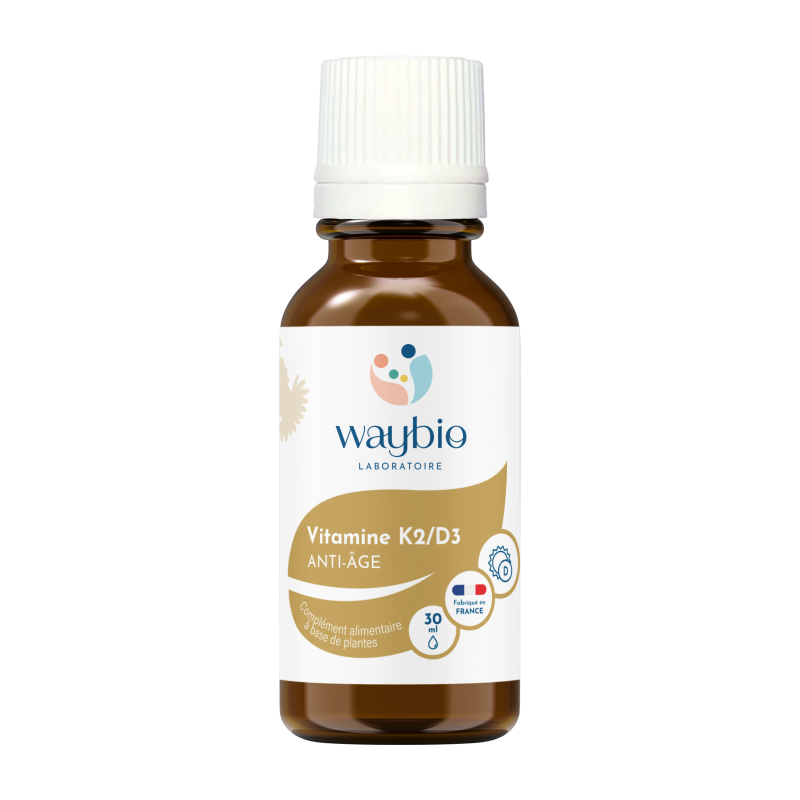
Vitamine K2/D3 offers a targeted combination of
two fat-soluble vitamins involved in the normal function of bone tissue. The daily serving of
10 drops provides
180 µg of vitamin K2 MK‑7 MenaQ7®, or 240% of the NRV, and
25 µg of vitamin D3 — equivalent to 1,000 IU and 500% of the NRV.
The formula comes in a
30 ml dropper bottle containing approximately 600 drops, corresponding to
60 days of use at the recommended dose.
Vitamin D3: making calcium availableVitamin D3, or cholecalciferol, acts upstream of bone mineralisation. After being processed by the body, it notably acts in the intestine to
promote the absorption of calcium and phosphorus from food.
These two minerals contribute to forming the hard part of bone. By facilitating their passage into the blood, vitamin D contributes to
maintaining a normal blood calcium concentration and provides the skeleton with the elements needed for its renewal.
Vitamin D3 also contributes to:
• the
maintenance of normal bones and teeth;
• the
normal function of muscles, which contribute to mobility and body stability;
• the
normal function of the immune system;
• the
process of cell division.
Its presence is particularly relevant during
periods of low sun exposure, since the skin naturally produces vitamin D under the action of UVB rays. However, the season, age, skin pigmentation, clothing and lifestyle can alter this production.
Vitamin K2 MK‑7: activating bone proteinsVitamin K is required to activate several proteins. In bone tissue, it notably acts on
osteocalcin, a protein produced by the cells responsible for forming bone.
Vitamin K transforms this protein so that it can
bind properly to minerals in the bone matrix. It therefore contributes to the
maintenance of normal bones. At the same time, it contributes to
normal blood clotting, which explains the
essential precautions in cases of anticoagulant treatment.
The formula uses
menaquinone‑7, or MK‑7, a long-chain form of vitamin K2. It disappears from the blood more slowly than vitamin K1, enabling a
more regular presence between two daily intakes.
Vitamin K takes its name from the Danish word
koagulation. It was discovered in the 1930s by
Henrik Dam, who received the 1943 Nobel Prize in Physiology or Medicine. Its role in activating bone proteins subsequently broadened the nutritional value of this vitamin beyond coagulation.
An identifiable K2 raw materialThe product contains
vitamin K2 MK-7 MenaQ7®, one of the world’s most documented forms of vitamin K2. Obtained through
natural fermentation, it stands out for its high content of the
all-trans form, the biologically active configuration of MK-7.
MenaQ7® is produced in Europe through
bacterial fermentation using a non-genetically modified Bacillus strain. It has a
purity above 97%, with nearly 99% of MK-7 in the all-trans form.
An oil base suited to fat-soluble vitaminsVitamins D and K are fat-soluble: they disperse in fats rather than water.
Rapeseed oil and the oil macerate therefore provide an appropriate vehicle for offering these vitamins in liquid form.
Milk thistle provides
18 mg of dry plant equivalent per daily serving. It completes the formula’s botanical matrix.
The formula’s distinctive characteristics •
180 µg of vitamin K2 MK‑7 MenaQ7® per day;
•
25 µg, or 1,000 IU, of vitamin D3;
• MK‑7 form obtained through
fermentation and rich in the all-trans configuration;
•
oil carrier suited to two fat-soluble vitamins;
• liquid presentation enabling an
intake of 10 drops;
• bottle corresponding to
two months of use.
Who is this product for?Vitamine K2/D3 may be particularly suitable for:
• adults wishing to
maintain their bone health every day;
•
people as they grow older, a period when bone renewal deserves particular attention;
•
postmenopausal women wishing to support their nutritional bone balance;
• adults with
little exposure to the sun or whose diet provides little vitamin D;
• active people looking for
combined support for bones and muscle function;
• those who prefer a
liquid presentation to tablets or capsules.
Ingredient synergyThe main complementarity is between
vitamin D3 and vitamin K2.
Vitamin D3 acts first: it promotes the intestinal absorption of calcium and phosphorus and contributes to maintaining a normal level of calcium in the blood. It therefore makes these minerals available to the tissues that need them.
Vitamin K2 then acts on bone proteins. In particular, it enables activation of osteocalcin so that this protein can bind to minerals in the bone matrix.
For the benefit related to calcium absorption,
vitamin D3 is therefore the main active ingredient.
Vitamin K2 complements its action by contributing to a different stage of bone function. Finally,
rapeseed oil acts as a carrier for these two fat-soluble vitamins.
What does the science say?A clinical study using the same MK‑7 dosageA
Dutch study published in 2013 sought to determine whether daily vitamin K2 MK‑7 supplementation could support the
maintenance of bone mass and strength after menopause.
The trial was
randomised, double-blind and placebo-controlled. It included
244 healthy women aged 55 to 65 who had been postmenopausal for at least two years.
For
36 months, participants received:
• either one capsule containing
180 µg of MK‑7 MenaQ7® per day;
• or an
identical placebo capsule without MK‑7.
The studied dose is therefore
identical to the 180 µg of MK‑7 provided daily by Vitamine K2/D3.
The researchers measured the
density and mineral content of the lumbar spine, femoral neck and hip. They also studied various bone-strength indices, vertebral height and the level of insufficiently activated osteocalcin.
After one year, the level of unactivated osteocalcin had
decreased by approximately 50% in the MK‑7 group. This change was maintained over the following two years, confirming the biological activity of vitamin K on this bone protein.
At the femoral neck, the decrease in density and mineral content was
slower with MK‑7. The difference from placebo became significant after three years for mineral content (
p = 0.011) and mineral density (
p = 0.012).
In the lumbar region, the loss of density and mineral content remained
below 1% in the MK‑7 group. However, after adjustment for age and body mass index, the effect on lumbar density became statistically borderline (
p = 0.070).
The loss of height measured at the centre of thoracic vertebrae T10 to T12 reached
−3.3 ± 2.0% with MK‑7, compared with −4.1 ± 2.2% with placebo after three years (
p = 0.003).
Six vertebral fractures were recorded in the placebo group, compared with one in the MK‑7 group.
These results support the value of a
prolonged intake of 180 µg of MK‑7 in supporting certain
bone-health parameters in healthy postmenopausal women.
Reference: Knapen MHJ, Drummen NE, Smit E, Vermeer C, Theuwissen E.
Three-year low-dose menaquinone-7 supplementation helps decrease bone loss in healthy postmenopausal women. Osteoporosis International. 2013;24(9):2499‑2507. DOI:
10.1007/s00198-013-2325-6 —
PubMed.





 Anti-aging
.png) Expertise based on experience and science
Expertise based on experience and science.png) Certified products
Certified products The best of nature