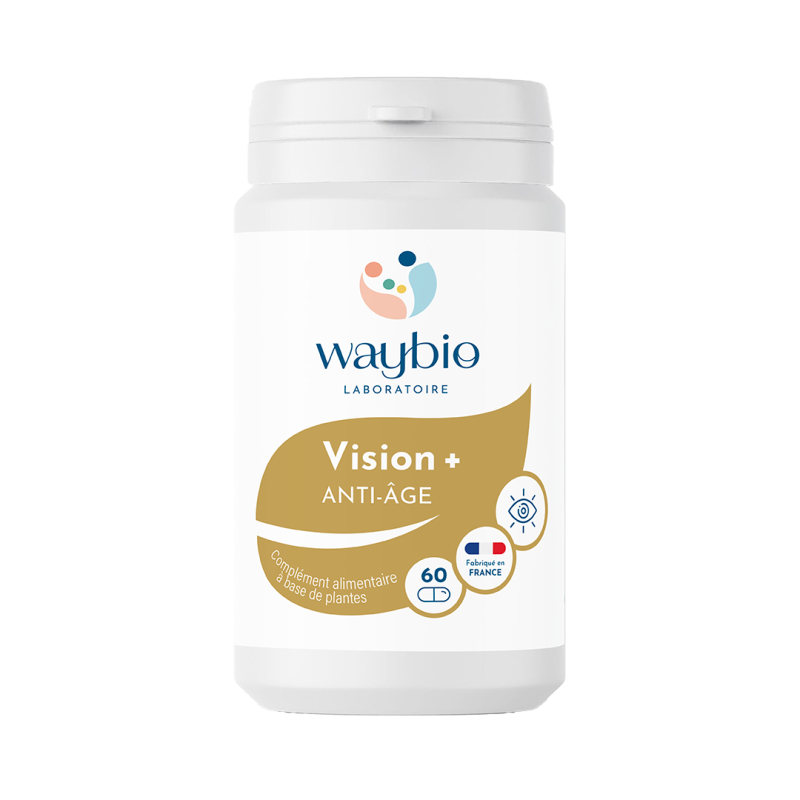
Vision+ offers a targeted formula for adults who wish to complement their diet with nutrients involved in visual function.
At a dose of 2 capsules, the formula provides 500 µg of vitamin A, 1.4 mg of vitamin B2 and 10 mg of zinc. These three nutrients contribute to the maintenance of normal vision. Vitamin B2, zinc and 12 mg of vitamin E also help protect cells against oxidative stress. These functions are recognized by European regulations on authorized health claims. Vitamin A is involved in the visual cycle, while zinc contributes to numerous enzymatic reactions that support the normal function of eye tissues. The formula uses zinc in bisglycinate form, a chelated form whose absorption proved superior to that of gluconate in a small crossover study involving 12 volunteers.
Lutein and zeaxanthin: at the heart of the formula
Marigold extract provides 10 mg of lutein and 2 mg of zeaxanthin. These two xanthophylls are components of macular pigment, which is concentrated in the center of the retina. It absorbs some short wavelengths of light and contributes to the antioxidant environment of the macula.
A meta-analysis of 46 studies involving 3,189 adults with healthy eyes observed, for intakes ranging from 5 to less than 20 mg per day, an average increase of 0.04 units in macular pigment optical density, with a 95% confidence interval of 0.02 to 0.07. The 12 mg of lutein and zeaxanthin provided by Vision+ fall within this studied range.
Marigold, or Tagetes erecta, has been used as a source of carotenoids for several decades. For standardized extracts intended for food supplements, the process generally described includes extracting the flowers, followed by saponification, purification and suspension in oil.
A complementary plant complex
The microalga Haematococcus pluvialis provides 2.2 mg of astaxanthin. This microalga naturally accumulates this red carotenoid. Astaxanthin complements the carotenoid profile of the formula.
Bilberry is present in two forms: 252 mg of leaf powder and 60 mg of fruit extract. The fruit of Vaccinium myrtillus is particularly known for its anthocyanins. In a clinical trial, 240 mg per day of a standardized bilberry extract improved certain objective accommodation parameters after screen-based tasks. This study supports the value of bilberry in formulas dedicated to visual comfort.
Finally, trans-resveratrol extracted from Japanese knotweed and quercetin from Sophora japonica enrich the formula with polyphenols.
The product is suitable for vegetarian and vegan diets.
Who is this product for?
Vision+ may be particularly suitable for:
• adults who wish to support their vision through targeted nutritional intake;
• people whose activities place high demands on their vision, particularly screen work, driving or precision tasks;
• adults who consume few foods naturally rich in lutein and zeaxanthin;
• people looking for a formula that combines support for normal vision and antioxidant protection of cells.
A complementary combination
The main benefit is based on vitamin A, vitamin B2 and zinc, which contribute to normal vision. Lutein and zeaxanthin complement this foundation by providing two components of macular pigment. Vitamin E, vitamin B2 and zinc also help protect cells against oxidative stress. Astaxanthin, bilberry, resveratrol and quercetin further broaden the carotenoid and polyphenol profile of the formula.
What science says
A US study published in 2014 evaluated exactly the amounts of lutein and zeaxanthin provided by 2 capsules of Vision+.
Researchers at the University of Georgia recruited 115 healthy young adults, mainly students aged around 23. Participants were assigned randomly and double-blind to two groups: 57 received a daily tablet containing 10 mg of lutein and 2 mg of zeaxanthin, while 58 received an identical placebo. It was taken at breakfast for one year. Measurements were repeated every three months.
The aim was to determine whether this combination could increase macular pigment density and alter several visual performance parameters: recovery after intense glare, perception of color contrast and resistance to glare.
After approximately 400 days, macular pigment optical density had increased by 0.101 units near the center of the macula in the supplemented group, reaching approximately 0.66. Blood concentrations of lutein and zeaxanthin had increased significantly from the first check at three months.
Recovery after photostress improved by approximately 8 to 9 seconds over the year, with a significant difference compared with placebo (p = 0.013). Chromatic contrast also improved by approximately 20% according to the authors’ estimate (p = 0.030).





 Anti-aging
.png) Expertise based on experience and science
Expertise based on experience and science.png) Certified products
Certified products The best of nature