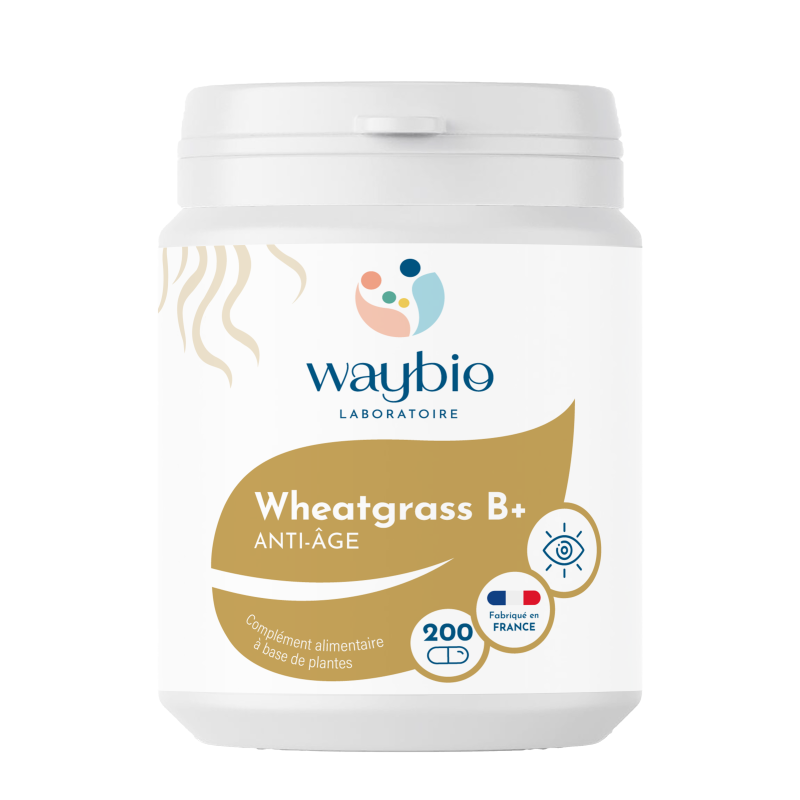
Wheatgrass B+ brings together several families of complementary nutrients: elements directly involved in
visual function,
carotenoids present in the macular environment and a combination of
antioxidant vitamins and minerals.
At the maximum daily dose of
6 capsules, our formula notably provides:
•
15 mg of zinc, equivalent to 150% of the NRV;
•
337 µg of provitamin A from dunaliella, equivalent to 42% of the NRV;
•
1.8 mg of lutein from marigold;
•
1.8 mg of zeaxanthin from pot marigold;
•
60 mg of vitamin C from acerola;
•
10 mg of vitamin E;
•
40 µg of selenium;
•
6 mg of lycopene.
Zinc and provitamin A: at the heart of visual function Zinc is the active ingredient primarily responsible for the formula’s “vision” objective. It contributes to the
maintenance of normal vision and
normal vitamin A metabolism. It is therefore involved in the reactions that enable the body to use this vitamin properly. It also contributes to the
protection of cells against oxidative stress. These functions are recognised by European regulations.
Dunaliella provides 337 µg of provitamin A. Once absorbed, provitamin carotenoids can be converted by the body into vitamin A according to its needs. In the retina, a derivative of this vitamin is a component of
light-sensitive pigments. When a ray of light reaches these pigments, their change in shape triggers the signal that is then transmitted to the brain. Vitamin A therefore contributes to the
maintenance of normal vision, particularly when brightness decreases.
Lutein and zeaxanthin: two pigments naturally present in the macula The
macula is the central area of the retina. It is involved in
precise vision, reading, detail recognition and colour perception. Lutein and zeaxanthin naturally concentrate there to form the
macular pigment.
These two carotenoids absorb some of the
short wavelengths of visible light, particularly in the blue-violet range. Their structure also enables them to interact with certain reactive molecules produced during exposure to light and sustained retinal activity. The formula provides
1.8 mg of each pigment, creating a
balanced combination of lutein and zeaxanthin.
Antioxidant protection organised on several levels The retina consumes a great deal of oxygen and contains lipid-rich membranes. Its activity therefore naturally exposes it to the formation of oxidising compounds. Wheatgrass B+ combines several nutrients that act in different locations:
•
Vitamin E acts mainly in lipid environments, particularly in cell membranes. It contributes to
slowing oxidation reactions that may spread there.
•
Vitamin C acts more in aqueous environments. It contributes to the
protection of cells and helps
regenerate the reduced form of vitamin E, allowing it to continue its antioxidant role.
•
Selenium is a component of specialised proteins, including glutathione peroxidases, which contribute to the
neutralisation of peroxides.
•
Zinc completes this system by also contributing to
protecting cells against oxidative stress.
This combination forms a
coherent network: vitamin E acts in contact with lipids, vitamin C supports its activity, while selenium and zinc support the body’s internal protective systems.
Complementary plant and pigment matrices Acerola is included as a source of vitamin C:
240 mg of acerola provides precisely 60 mg of this vitamin, equivalent to 75% of the NRV.
Lycopene completes the carotenoid spectrum. Unlike the provitamin carotenoids from dunaliella, it is not converted into vitamin A. It belongs to the
fat-soluble pigment fraction of the formula, alongside lutein and zeaxanthin.
Spirulina and dunaliella are two naturally pigmented raw materials.
Grape seed forms a matrix naturally containing phenolic compounds. Finally,
wheat germ is the main plant ingredient, with
1,224 mg per daily dose.
Our formula therefore stands out for its
high zinc content and significant amounts of
vitamins C and E, provitamin A and selenium, complemented by
two quantified macular pigments.
Who is this product for? Wheatgrass B+ may be particularly suitable for:
• adults wishing to supplement their diet with nutrients involved in the
maintenance of normal vision;
• people whose days
place high demands on their vision: precision work, prolonged reading or regular screen use;
• adults looking for a formula combining
carotenoids and antioxidant micronutrients;
• people whose diet contains
few fruits, colourful vegetables or varied sources of carotenoids;
• those wishing to incorporate
nutritional support for vision into a regular, long-term approach.
Ingredient synergy The synergy of
Wheatgrass B+ is based on
three complementary levels:
1. Zinc and provitamin A are directly involved in the visual pathway. Zinc is the active ingredient primarily responsible for the claimed benefit, as it contributes to the
maintenance of normal vision and
vitamin A metabolism.
2. Lutein and zeaxanthin are naturally present in the macula. They add a more targeted dimension concerning the
macular pigment and its interaction with short light wavelengths.
3. Vitamins C and E, selenium and zinc together contribute to the
protection of cells against oxidative stress. Vitamin C helps
regenerate the reduced form of vitamin E.
What does the science say? Lutein and zeaxanthin in intensive screen users In 2025, a Perth-based team in Australia studied the value of lutein and zeaxanthin supplementation in
70 healthy adults aged 18 to 65 who used screens for more than 6 hours per day.
Participants were randomly divided into
two groups of 35. For
180 days, the first group received one capsule daily providing
10 mg of lutein and 2 mg of zeaxanthin isomers in the Lute-gen® form, while the second received a sunflower-oil placebo. The active capsules also contained this oil as a carrier. The main final analyses included
29 participants in the active group and 31 in the placebo group.
After six months, changes in several objective measurements were
favourable to the supplemented group:
• in the Schirmer test, which assesses tear production, the adjusted score
increased by 2.09 mm in the active group, compared with a decrease of 2.02 mm with placebo;
• tear-film break-up time
increased by 8.50 seconds with lutein and zeaxanthin, compared with a decrease of 0.90 seconds with placebo;
• the time needed to recover vision after intense light
decreased by 1.45 seconds in the active group, whereas it increased by 2.58 seconds with placebo.
These results show that daily supplementation with
lutein and zeaxanthin over this period may support certain
objective parameters of the tear film and recovery after bright light in regular screen users.
Full reference: Lopresti AL, Smith SJ.
The effects of lutein/zeaxanthin (Lute-gen®) on eye health, eye strain, sleep quality, and attention in high electronic screen users: a randomized, double-blind, placebo-controlled study. Frontiers in Nutrition. 2025;12:1522302. DOI:
10.3389/fnut.2025.1522302 —
PubMed Central.





 Anti-aging
.png) Expertise based on experience and science
Expertise based on experience and science.png) Certified products
Certified products The best of nature