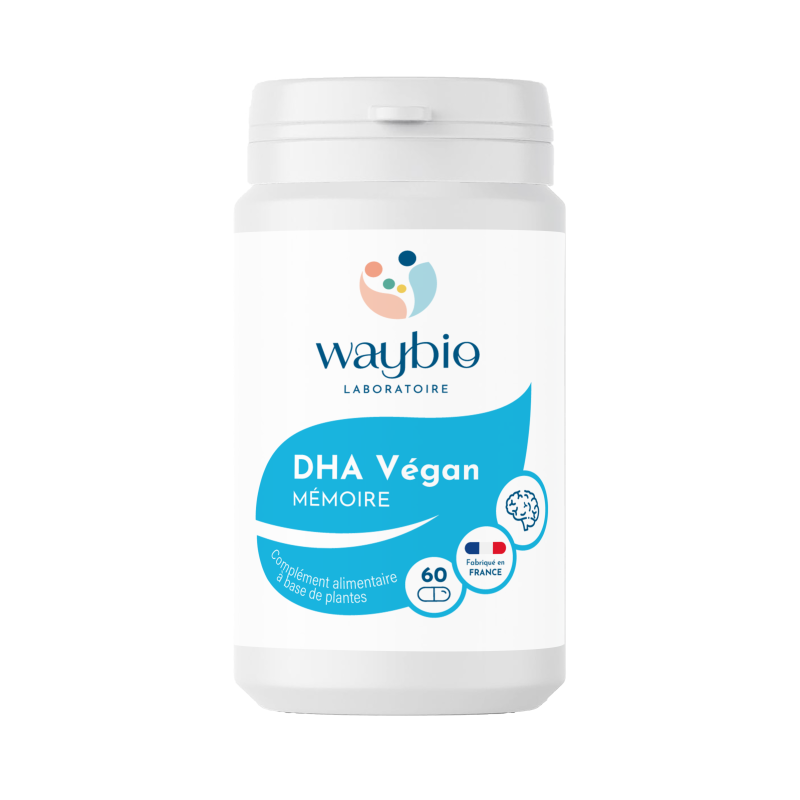
DHA végan provides, in
a single daily capsule,
250 mg of DHA from
336 mg of Schizochytrium sp. microalgae oil. This amount corresponds to the daily intake associated with the
maintenance of normal brain function and vision under European regulations.
Unlike flaxseed, chia seed or walnuts, which mainly provide the precursor ALA, this oil provides
DHA directly. It is therefore a particularly suitable source for people who eat
little or no fish.
DHA: an essential component of brain membranesDHA is a
long-chain omega-3 that is incorporated into phospholipids, the fats forming cell envelopes. Its highly flexible structure helps membranes retain the
mobility needed for the proteins they contain to function properly.
In the brain, DHA is particularly abundant in the
membranes of neurons and synapses, the areas where nerve cells exchange information. It therefore contributes to the environment in which receptors, ion channels and nerve-signal transmission systems operate. This structural role explains its contribution to
normal brain function.
With
250 mg of DHA per capsule, the formula reaches the daily intake associated with this physiological effect. It can support periods when
mental capacities are under heavy demand, for example during sustained intellectual work, study or a demanding professional pace, without acting as a stimulant.
Structural support for the retinaThe retina also contains a high proportion of DHA, notably in the
photoreceptor membranes. These cells capture light and convert it into a signal sent to the brain.
DHA helps create a
membrane environment favourable to the function of rhodopsin, a light-sensitive protein. It therefore supports the renewal and normal function of retinal structures. The daily dose of
250 mg also qualifies for the claim that DHA contributes to the
maintenance of normal vision.
A microalgae source without fish oilSchizochytrium is a single-celled marine microorganism capable of naturally accumulating
large quantities of DHA. Microalgae are the original source of the omega-3s found in the marine food chain: fish notably accumulate them through their diet.
Using microalgae oil directly therefore provides
DHA without the use of fish oil. Our formula is a
100% plant-based alternative, suitable for
vegetarian, vegan and seafood-free diets.
Schizochytrium oils have been used in the European Union since their
first authorisation as a novel food in 2003. Their commercial production is based on
controlled cultivation through fermentation, followed by biomass recovery and oil extraction.
Vitamin D3: essential complementary supportThe formula also provides
20 µg of vitamin D3 (400% of the NRV), a fat-soluble vitamin whose biological activity relies on its interaction with receptors found in many tissues of the body.
Vitamin D3 notably contributes to:
• the
normal function of the immune system;
• the
maintenance of normal muscle function;
• the
normal absorption and utilisation of calcium and phosphorus;
• the
maintenance of normal bones.
Its inclusion in an
oil-based lipid matrix is consistent with its fat-soluble nature, promoting its incorporation into physiological processes related to dietary fats.
Main characteristics •
250 mg of DHA per capsule;
•
Schizochytrium sp. microalgae oil;
•
direct source of DHA without fish oil;
•
vegetable capsules;
•
60 capsules, or 60 days of use;
•
a single daily intake;
•
100% plant-based formula;
•
20 µg of vitamin D3 (400% of the NRV).
Who is this product for?DHA végan may be particularly suitable for:
•
vegetarians or vegans looking for a direct source of DHA;
• people who eat
little or no oily fish;
• those wishing to
support their normal brain function;
• people under
heavy intellectual demand;
• people who spend a lot of time in front of screens and wish to
preserve normal vision;
• those looking for an
alternative to fish oils;
• people who favour a
simple intake limited to one capsule per day;
• people who also wish to
support immunity, muscle function and bones through vitamin D3.
Ingredient synergyThe active ingredient mainly responsible for the brain and visual benefits is
DHA.
Schizochytrium oil plays a dual role: it is the
natural source of DHA, and its
lipid matrix facilitates its incorporation into the body.
Vitamin D3 complements DHA with distinct physiological functions. While DHA acts mainly on the
structure of neuronal and retinal membranes, vitamin D3 contributes to
immunity, muscle function and calcium metabolism. Their combination in a single formula therefore covers
complementary physiological areas.
What does the science say?A
clinical study conducted in Madrid between March and July 2021 assessed the absorption of DHA from
Schizochytrium in people following different diets.
The researchers included
116 healthy adults aged 18 to 45: omnivores who ate little fish, lacto-ovo vegetarians and vegans. The trial was
randomised, double-blind, placebo-controlled and organised according to a crossover protocol. A total of
98 participants provided final data for both periods.
Each participant successively received:
• one capsule providing
250 mg of DHA from Schizochytrium sp. in 625 mg of lipids;
• one placebo capsule containing
625 mg of olive oil.
Each period lasted
5 weeks, with an intermediate 5-week period without supplementation. The capsules were taken
once daily with one of the main meals.
After the supplementation period, the proportion of DHA among serum fatty acids was
significantly higher than with placebo in all three groups:
Omnivores eating little fish: 1.94% (placebo) → 2.40% (microalgae DHA)Lacto-ovo vegetarians: 1.26% (placebo) → 1.87% (microalgae DHA)Vegans: 0.75% (placebo) → 1.74% (microalgae DHA)The increase was
statistically significant in all groups (p < 0.001) and particularly marked in vegan participants, whose
serum DHA proportion more than doubled. The ratio of omega-6 to omega-3 also improved during supplementation.
These results show that a daily intake of DHA from
Schizochytrium is
well absorbed and effectively increases the presence of DHA in circulating lipids, including in vegetarians and vegans.
Full reference: García-Maldonado E, Alcorta A, Zapatera B, Vaquero MP.
Changes in fatty acid levels after consumption of a novel docosahexaenoic supplement from algae: a crossover randomized controlled trial in omnivorous, lacto-ovo vegetarians and vegans. European Journal of Nutrition. 2023;62(4):1691-1705. DOI:
10.1007/s00394-022-03050-3.
Full text on PubMed Central.





 Memory
.png) Expertise based on experience and science
Expertise based on experience and science.png) Certified products
Certified products The best of nature