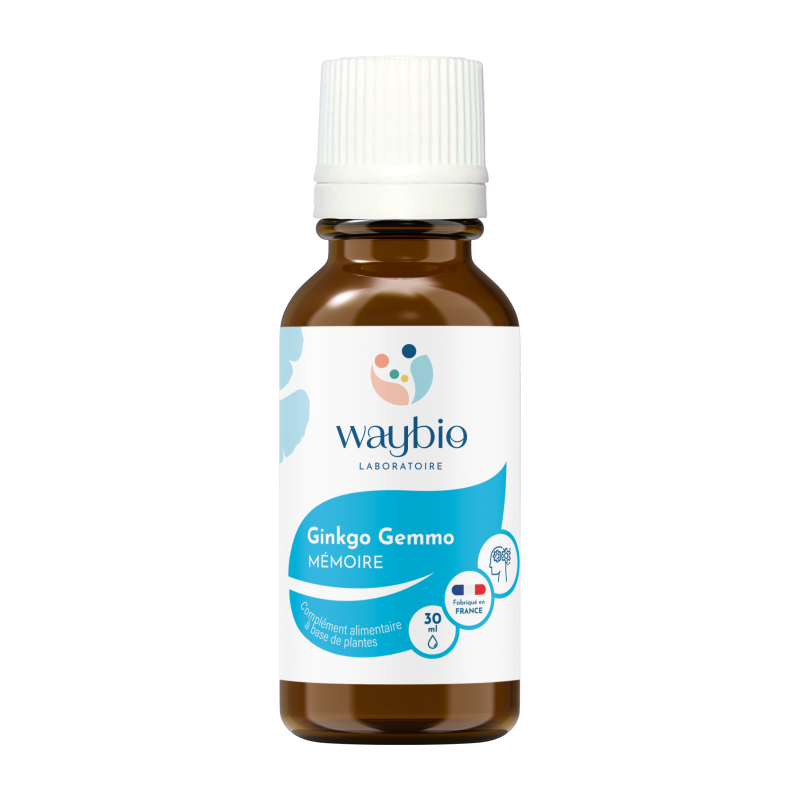
Ginkgo gemmo is a
single-plant liquid formula supplied in a dropper bottle. At the maximum recommended daily dose of
15 drops, it provides
37.5 mg of young ginkgo shoots as a dry-plant equivalent. Its
30 ml format contains approximately
600 drops and allows the daily intake to be adjusted between
5 and 15 drops.
Native to China,
Ginkgo biloba belongs to a
very ancient plant lineage of which it is now the only living representative. It is sometimes described as a
“living fossil” because of the similarity between its present-day leaves and those found as fossils. Its use as a plant of interest dates back
several centuries in Asia.
This formula differs from conventional leaf-based supplements: it uses
young shoots, meaning plant parts in full growth. Their preparation as a
glycerinated hydroalcoholic extract follows the principle of
gemmotherapy macerates. The water phase and alcohol dissolve different families of plant molecules, while glycerine completes the extraction and acts as a liquid carrier. The choice of solvents directly influences the final profile of a plant macerate.
Microcirculation is the network of the smallest blood vessels:
arterioles, capillaries and venules. This is where oxygen and nutrients pass from the blood into tissues, while carbon dioxide and cellular waste are collected. The efficiency of these exchanges depends in particular on the
diameter of the vessels, the function of their inner lining and blood fluidity.
Ginkgo is included in our formula to
support circulation in small blood vessels. The best-characterised ginkgo preparations, obtained from the leaves, have effects on
vascular tone, regional circulation and certain parameters of blood fluidity. These actions may promote better adaptation of blood flow to tissue needs, notably in the
peripheral and cerebral regions.
Ginkgo is also selected for its
antioxidant activity. The body’s normal functioning produces reactive molecules called free radicals. When they become too numerous, they can oxidise membrane lipids and disrupt the cells lining blood vessels. The
flavonoids characterised in ginkgo leaves help neutralise these reactive molecules, while certain
terpene lactones are involved in regulating messengers associated with vascular function and platelet activation.
This dual approach—
circulatory support and antioxidant balance—also explains the traditional interest in ginkgo for
memory. The brain depends on a continuous supply of oxygen and glucose. Circulation capable of meeting its needs and better protection against oxidative stress help preserve the conditions required for
communication between neurons, the recording of information and its recall.
The formula can therefore support adults wishing to
support their microcirculation or maintain their memory, particularly during
intellectually demanding periods or as they grow older. It is not presented as an immediate stimulant, but as a plant-based supplement intended to be incorporated into
regular use.
Who is this product for? Ginkgo gemmo may be particularly suitable for:
• adults wishing to
support their microcirculation;
• people attentive to
maintaining their memory and recall abilities;
• adults looking for
plant-based support during a period of intellectual demand;
• people who prefer a
simple formula containing a single active plant;
• users who appreciate
liquid supplements whose number of drops can be adjusted within the recommended range;
• consumers looking for an ingredient
from organic farming and certified organic by Ecocert.
What does the science say? A clinical trial on peripheral circulation In 2002, a team at the University of Dundee in Scotland assessed a
standardised Ginkgo biloba extract in adults with primary Raynaud’s phenomenon, characterised by episodes of excessive contraction of the small blood vessels in the fingers in response to cold or emotions.
The trial was
randomised, double-blind and placebo-controlled.
Twenty-two people aged 18 to 52 were recruited;
19 were ultimately included in the analysis, with 9 in the ginkgo group and 10 in the placebo group.
After two weeks of observation, participants received the following for
10 weeks:
• either
120 mg of standardised Seredrin extract three times per day, equivalent to 360 mg per day;
• or
an identical-looking placebo.
Participants recorded the frequency, duration and severity of their episodes each day. In the ginkgo group, the average number decreased from
13.2 ± 16.5 to 5.8 ± 8.3 per week, a reduction of 56%. In the placebo group, it decreased from
14.6 ± 10.7 to 10.7 ± 12.3, a reduction of 27%. The difference between groups was
statistically significant.
Full reference: Muir AH, Robb R, McLaren M, Daly F, Belch JJF.
The use of Ginkgo biloba in Raynaud’s disease: a double-blind placebo-controlled trial.
Vascular Medicine. 2002;7(4):265-267. DOI:
10.1191/1358863x02vm455oa —
PubMed





 Memory
.png) Expertise based on experience and science
Expertise based on experience and science.png) Certified products
Certified products The best of nature