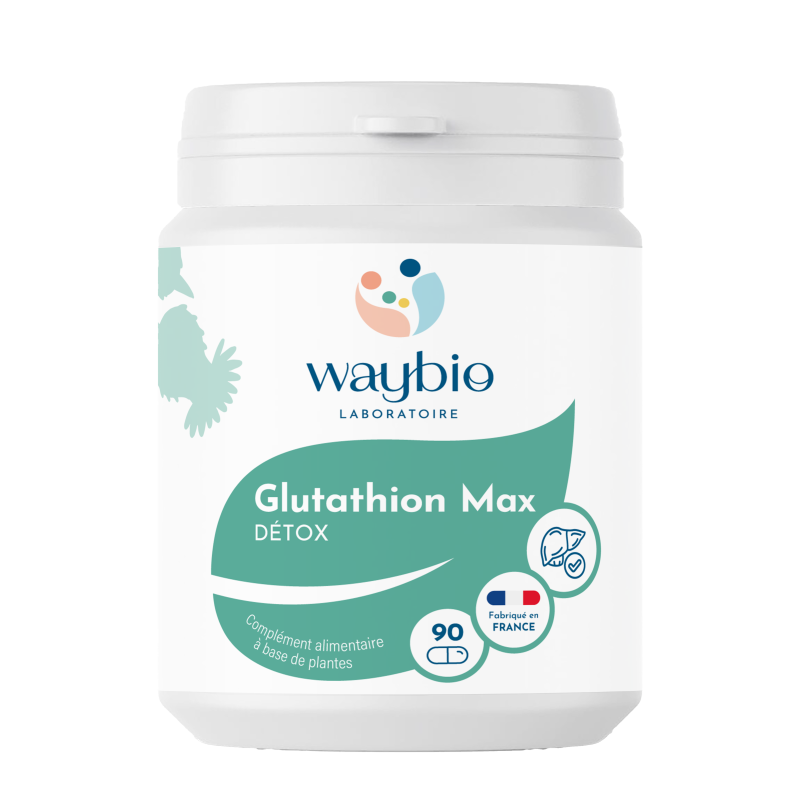
Glutathion Max brings together
four complementary active ingredients centred on the body’s natural antioxidant system. At the maximum daily dose of
three capsules, our formula provides
499 mg of N-acetylcysteine,
300 mg of reduced L-glutathione,
150 mg of milk-thistle extract and
55 µg of selenium, equivalent to 100% of the nutrient reference value.
Reduced glutathione at the heart of the formula Glutathione is a small molecule produced by the body from
three amino acids: glutamate, cysteine and glycine. It is naturally present inside cells, where it contributes to
maintaining their balance in the face of oxidation reactions produced by metabolism.
We use
L-glutathione in its reduced form, known as GSH. This form can donate electrons to help certain enzymes neutralise peroxides. After this reaction, glutathione changes into an oxidised form, before another enzyme converts it back into reduced glutathione. This recycling enables the body to maintain a genuine
cellular protection circuit.
Glutathione is also involved in certain processes carried out by the liver. Enzymes called
glutathione S-transferases can attach it to various reactive compounds. The products formed generally become easier to transport and then eliminate through bile or urine. It therefore contributes to
one of the natural transformation pathways used by liver cells, without acting as a mechanical liver “cleanser”.
NAC to provide the required cysteine N-acetylcysteine, or NAC, is a form derived from L-cysteine. After absorption, it can be converted into
cysteine, one of the three elements essential for producing glutathione.
Cysteine availability is frequently one of the factors limiting the rate of glutathione synthesis. The
499 mg of NAC therefore logically complements the
300 mg of reduced glutathione: glutathione directly supplies the already-formed molecule, while NAC provides the body with
one of its main building materials.
In this combination, the best-documented value of NAC lies primarily in its
role as a precursor and its antioxidant action.
Selenium to support antioxidant enzymes Glutathion Max provides
55 µg of selenium in an organic L-selenomethionine form, equivalent to 100% of the NRV. Once metabolised, selenium can be used to produce
selenoproteins, including several glutathione peroxidases.
These enzymes specifically use reduced glutathione to convert hydrogen peroxide and certain lipid peroxides into less reactive compounds.
Glutathione provides the electrons required for the reaction, while
selenium is part of the structure of the enzyme that performs it.
Selenium officially contributes to
protecting cells against oxidative stress. It also contributes to the
normal function of the immune system. Both functions are recognised by the European Commission.
L-selenomethionine is an organic form similar to the amino acid methionine. In nature, plants convert selenium present in soil into selenomethionine and selenocysteine.
Milk thistle for targeted liver support Milk thistle, Silybum marianum, is a plant in the Asteraceae family. Its native range extends notably from the Mediterranean basin to Central Asia and India. Its traditional use dates back
more than 2,000 years, primarily in relation to liver and digestive functions.
The part of the plant most commonly documented is the
fruit. It contains a group of flavonolignans called
silymarin, of which silybin is one of the main constituents. These compounds contribute to the value of milk thistle in
supporting normal liver-cell function and their antioxidant environment.
The European Medicines Agency recognises the
traditional use of milk-thistle fruit preparations to support liver function. These preparations may be obtained by drying and grinding the fruit or by extraction using a solvent that is subsequently partly or completely evaporated.
A formula organised around the glutathione system Glutathion Max stands out through its
four-level approach:
•
reduced glutathione directly provides the central molecule of the system;
•
NAC provides cysteine to support its production by the body;
•
selenium contributes to the structure of the enzymes that use glutathione and helps protect cells against oxidative stress;
•
milk thistle directs the formula towards supporting liver function.
The formula therefore stands out above all for the
complementarity of its doses:
300 mg of reduced glutathione combined with 499 mg of NAC, complemented by
a full NRV of selenium and 150 mg of milk-thistle extract.
Who is this product for? Glutathion Max may be particularly suitable for:
• adults wishing to
support the normal function of their liver;
• people looking for a formula built around
glutathione and its precursor, NAC;
• adults wishing to increase their selenium intake to support the
protection of cells against oxidative stress;
• people wishing to support the
normal function of their immune system through selenium;
•
vegetarian or vegan people, as our product is compatible with both diets.
Ingredient synergy Glutathione is the molecule primarily involved in the antioxidant balance presented here.
NAC supports it by providing cysteine, which is required for its production.
Selenium acts at another level: it is a component of
glutathione peroxidases, the enzymes that use glutathione to reduce certain peroxides.
Milk thistle completes this trio by providing the formula’s
liver support. The complementarity therefore concerns several stages of the same system, without claiming any particular improvement in glutathione absorption.
What does the science say? Can oral supplementation increase glutathione stores? A clinical trial conducted at the
Penn State Hershey Cancer Institute in Pennsylvania sought to determine whether orally consumed glutathione could
sustainably increase the concentrations measured in different compartments of the body.
Published in 2015, this
randomised, double-blind, placebo-controlled trial involved
54 healthy, non-smoking adults. Participants were aged
28 to 72, with an average age of 46.6; 76% were women.
They were divided into three groups:
•
16 participants received two placebo capsules containing cellulose;
•
18 participants received 250 mg of glutathione per day, as two 125 mg capsules;
•
20 participants received 1,000 mg of glutathione per day, as two 500 mg capsules.
Supplementation lasted
six months, followed by one month without supplementation. The researchers measured glutathione in whole blood, red blood cells, plasma, lymphocytes and oral cells.
After six months, the dose of
250 mg per day—close to the 300 mg provided by three Glutathion Max capsules—resulted in an
average increase of 17% in whole-blood glutathione and 29% in red blood cells, with a statistically significant difference.
This dose also
reduced the ratio of oxidised to reduced glutathione in the blood, an indicator used to assess oxidative balance.
These results support the conclusion that
daily oral glutathione intake can increase certain measurable glutathione stores, including at 250 mg per day.
Full reference: Richie JP Jr, Nichenametla S, Neidig W, Calcagnotto A, Haley JS, Schell TD, Muscat JE.
Randomized controlled trial of oral glutathione supplementation on body stores of glutathione. European Journal of Nutrition. 2015;54(2):251-263.
DOI: 10.1007/s00394-014-0706-z —
PubMed —
Registration NCT01044277.





 Detox
Detox
.png) Expertise based on experience and science
Expertise based on experience and science.png) Certified products
Certified products The best of nature