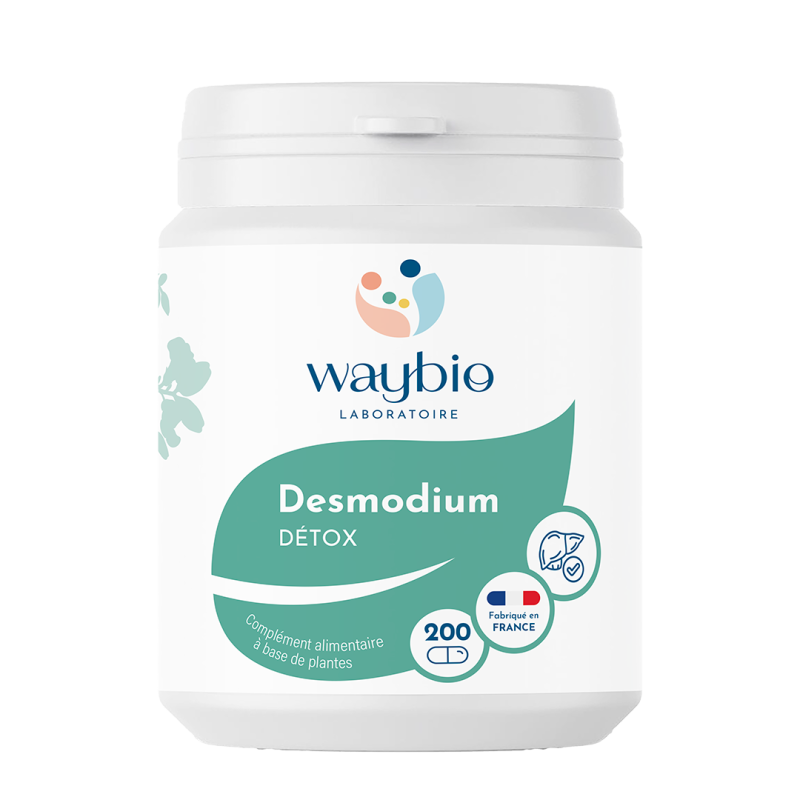
Targeted plant-based support for liver functionWaybio Desmodium is based on a simple formula:
powdered desmodium leaf presented in
vegetable capsules. A serving of
six capsules provides 1.2 g of the plant.
Desmodium is traditionally associated with
supporting liver function. Its value stems from the liver’s central role in the body’s balance. This organ
processes nutrients absorbed during digestion, stores some glucose as glycogen, participates in fat and protein metabolism and
produces bile, which is needed to digest lipids.
The liver is also involved in the body’s
natural elimination mechanisms. Its cells, called
hepatocytes, modify many substances originating from food, metabolism or the environment. They can then bind them to other molecules to facilitate their elimination in bile or urine. A so-called “detox” approach therefore consists above all in
supporting these physiological functions that the body already performs continuously.
The leaf’s natural constituentsDesmodium leaf contains several families of plant compounds:
•
flavonoids and polyphenols, notably vitexin and isovitexin derivatives;
•
D-pinitol, a natural compound related to the sugar family;
•
saponins and other secondary constituents present in the plant matrix.
Flavonoids contribute to
antioxidant balance. They can neutralise certain reactive molecules before these sustain oxidation reactions liable to alter the lipids in cell membranes. This role explains their value in a formula designed to support an
organ with particularly intense metabolic activity.
Certain desmodium flavonoids are present in relatively stable forms during digestion. They can therefore reach different stages of the digestive system before being transformed, notably through the action of the
intestinal microbiota.
D-pinitol completes this plant profile and is one of the compounds associated with desmodium’s
liver-support mechanisms.
A tropical plant with a long history of useDesmodium belongs to the
Fabaceae family. It is a creeping or climbing herbaceous plant, recognisable by its leaves made up of three leaflets and its small flowers arranged in clusters. Native to
equatorial Africa, it grows wild. Botanical data more broadly describe a tropical species found in Africa and the Americas.
Its use developed in France from the
1960s, after the physician
Pierre Tubéry gathered information in Cameroon about its traditional preparations. These generally used the
dried aerial parts as a decoction.
When should desmodium be added to your routine?This formula may have a place:
• after a period when
the diet has been richer or denser;
• during a
change of pace or season;
• as part of an approach intended to
support natural elimination functions;
• when seeking
targeted plant-based support for liver function;
• as part of a
simple, single-plant routine.
Who is this product for?This supplement may be particularly suitable for:
• people wishing to
support the normal function of their liver;
• those going through a period of
richer eating or changing habits;
• people looking for a
single-plant formula without a complex blend of active ingredients;
• users who prefer
whole-leaf powder to a concentrated extract;
• people wishing to include
liver support in a seasonal routine.
What does the science say?A comparative human observation of liver toleranceA
2015 publication reports on an observation conducted
from 2003 to 2013 at the SH Centre in the Republic of San Marino. Its aim was to examine changes in various
liver markers and digestive tolerance in people receiving chemotherapy, according to whether or not they consumed desmodium.
The article reports the monitoring of
153 people with metastatic intestinal or breast cancer. However, its detailed table assigns
143 participants to four groups, which is a counting discrepancy in the publication.
All participants followed the same diet. Some of them received desmodium in the form of
500 ml of herbal tea, divided throughout the day three days a week, starting
15 days before chemotherapy.
In the group of
48 people with metastatic intestinal adenocarcinoma:
• nausea affected
22% of those consuming desmodium, compared with 67% without desmodium;
• abnormal alkaline phosphatase values were found in
33% of people taking desmodium, compared with 71% in the comparison group;
• abnormal transaminase values were observed in
22% versus 43%, but this latter difference was not statistically significant.
Among
40 patients with a breast tumour and liver metastases:
• nausea affected
8% of the desmodium group, compared with 40% of the comparison group;
• alkaline phosphatase values were abnormal in
20% versus 80%;
• transaminase values were abnormal in
16% versus 47%.
Reference: Tubéry P., Ragot J., Lagarde P., Authier-Derivaux D., Pidoux M., Rasolohery C., Bourdy G.
Desmodium adscendens. De l’usage traditionnel camerounais contre les hépatites à l’accompagnement des chimiothérapies. Hegel. 2015;5(4):268–282.
DOI: 10.4267/2042/57914.





 Detox
Detox
.png) Expertise based on experience and science
Expertise based on experience and science.png) Certified products
Certified products The best of nature