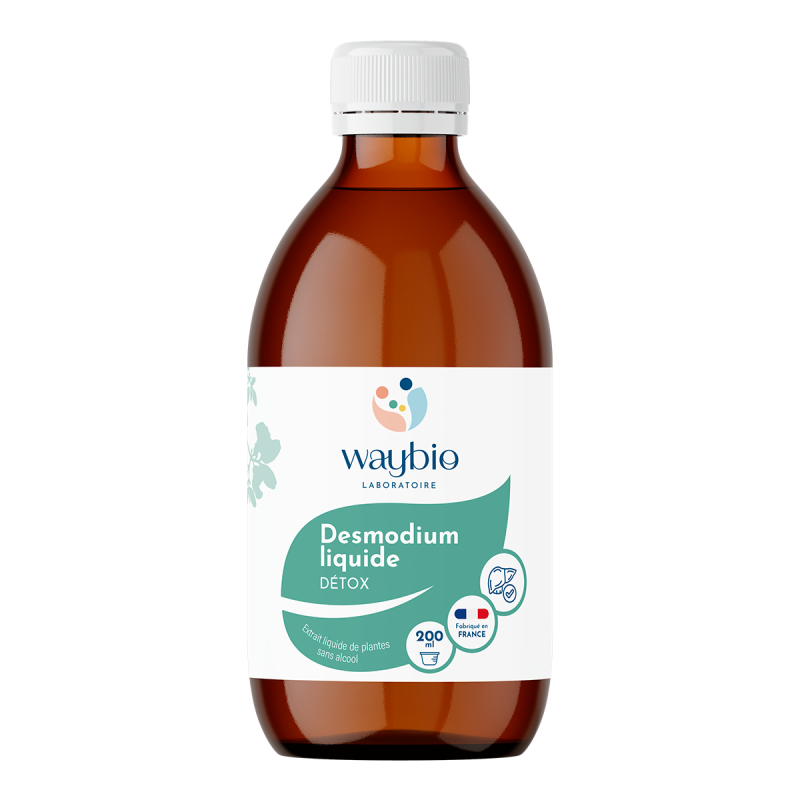
A concentrated Desmodium liquide formulaWaybio Desmodium liquide is a food supplement to be diluted in water. Its formula is based on a
desmodium leaf extract, providing
5 g of dry plant equivalent per three capfuls, or 30 ml.
The
liquid form makes it easy to spread intake throughout the day, notably by diluting
the three capfuls in one litre of water. The
natural lemon flavour improves the taste of the preparation.
The liver, an essential processing centreThe liver is continuously involved in managing substances circulating in the body. It
processes carbohydrates, lipids and proteins from food. In particular, it can
store some glucose as glycogen, then make it available again between meals when the body needs it.
Liver cells, called
hepatocytes, also modify many molecules originating from food, the environment or the body’s normal functioning. Some are transformed and then bound to other substances to be more easily
eliminated in bile or urine.
The liver also produces
bile, which is needed to digest and absorb fats. It is also involved in producing many circulating proteins. Supporting liver function therefore means supporting several mechanisms related to
metabolism, digestion and natural elimination.
How does desmodium support these functions?Desmodium is traditionally used to
support the liver. It naturally provides several families of plant constituents:
•
flavonoids, including vitexin and isovitexin derivatives;
• various
polyphenols;
•
D-pinitol, a natural compound related to the sugar family;
•
saponins and other secondary constituents.
Flavonoids contribute to
antioxidant balance. They can neutralise certain reactive molecules before these propagate oxidation reactions around cell membranes and proteins. This function is particularly valuable for the liver, whose
metabolic activity naturally produces reactive compounds.
Certain desmodium flavonoids have a relatively stable chemical bond. Under simulated digestion conditions,
vitexin and isovitexin derivatives withstand the initial digestive stages before being partially transformed in the intestine. This describes the behaviour of certain plant constituents, without making it possible to quantify their absorption from this supplement.
D-pinitol completes this phytocomplex. It is considered one of the markers associated with the
liver support provided by desmodium, together with flavonoids and the other constituents naturally present in the leaf.
Synergy within the leafDesmodium is the ingredient mainly responsible for the liver benefit presented. The complementarity does not rely on combining several plants, but on the
coexistence of different constituents in the leaf extract.
Flavonoids support antioxidant balance around liver cells.
D-pinitol completes the plant’s metabolic profile, while the leaf’s other compounds contribute to the overall
phytocomplex.
The origin and history of desmodiumDesmodium belongs to the
Fabaceae family. This creeping or climbing herbaceous plant bears leaves made up of three leaflets and small flowers arranged in clusters.
Native to
equatorial Africa, it grows wild. Botanical references more broadly describe a tropical species naturally found in Africa and the Americas.
Its use spread in France from the
1960s, after the physician
Pierre Tubéry gathered information in Cameroon about its traditional uses. At the time, the aerial parts were generally prepared as a
decoction in water.
When should it be used?This formula may be included:
• after a period when
the diet has been richer;
• during
changes of season or pace;
• when wishing to
support natural elimination mechanisms;
• in a routine devoted to
maintaining liver function;
• when you prefer a
diluted solution to drink gradually rather than capsules;
• when looking for a
formula based on a single active plant.
Desmodium
does not act as a purge. It supports the
physiological functions already performed by the liver every day.
Who is this product for?Desmodium liquide may be particularly suitable for:
• people wishing to provide
targeted plant-based support for their liver function;
• those who prefer to
dilute their supplement in a glass or bottle of water;
• people seeking a
concentrated intake, with 5 g of dry plant equivalent at the maximum dose;
• those wishing to
spread their intake throughout the day;
• users who prefer a
single-plant formula with a lemon flavour.
What does the science say?A comparative human observation using desmodium herbal teaA
2015 publication reports on an observation conducted
from 2003 to 2013 at the SH Centre in the Republic of San Marino. Its aim was to examine
digestive tolerance and changes in various liver markers in people receiving chemotherapy, with or without desmodium consumption.
The article reports
153 participants with metastatic intestinal or breast cancer.
The participants followed the same diet. Some of them consumed
500 ml of desmodium herbal tea, which was then diluted in one litre of water and divided throughout the day. The herbal tea was used
three days a week, starting
15 days before chemotherapy.
In a first group of
48 people with metastatic intestinal adenocarcinoma:
• nausea affected
22% of people taking desmodium, compared with 67% without desmodium;
• abnormal alkaline phosphatase values were found in
33% versus 71%;
• abnormal transaminase values were observed in
22% versus 43%, with no statistically significant difference for this latter parameter.
In a group of
40 patients with a breast tumour and liver metastases:
• nausea affected
8% of the desmodium group, compared with 40% of the comparison group;
• alkaline phosphatase values were abnormal in
20% versus 80%;
• transaminase values were abnormal in
16% versus 47%.
Reference: Tubéry P., Ragot J., Lagarde P., Authier-Derivaux D., Pidoux M., Rasolohery C., Bourdy G.
Desmodium adscendens. De l’usage traditionnel camerounais contre les hépatites à l’accompagnement des chimiothérapies. Hegel. 2015;5(4):268–282.
DOI: 10.4267/2042/57914.





 Detox
Detox
.png) Expertise based on experience and science
Expertise based on experience and science.png) Certified products
Certified products The best of nature