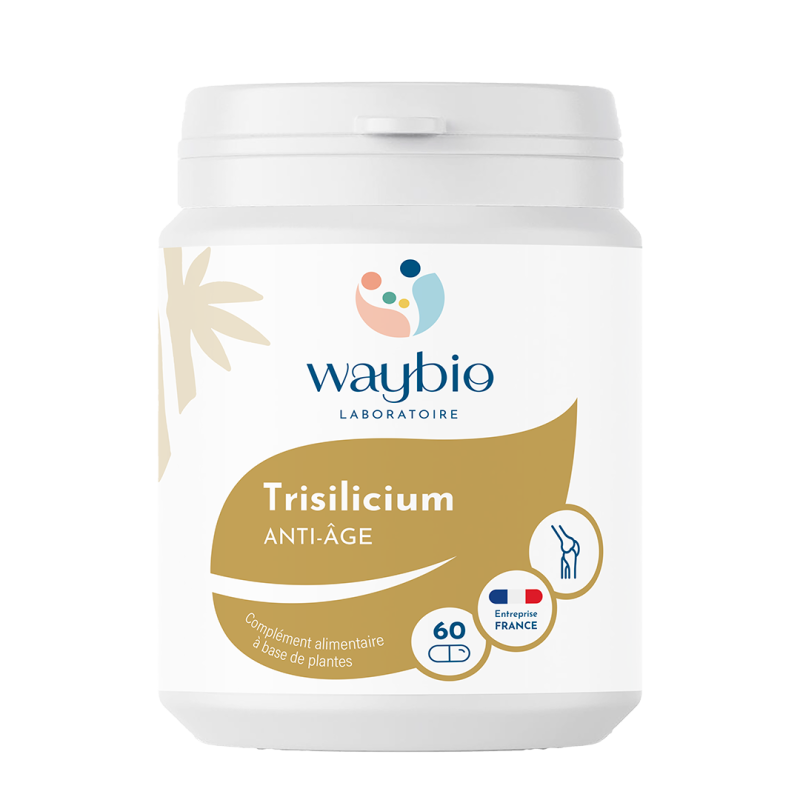
Trisillicium brings together
three complementary sources of silicon in a formula for adults wishing to support their
mobility, joint comfort and the strength of their supporting tissues.
Silicon at the heart of connective tissuesCartilage, tendons, ligaments and the flexible part of bone rely on a matrix mainly composed of
collagen and molecules capable of retaining water.
In cartilage, collagen fibres form a
strong framework, while proteoglycans retain water and enable the tissue to cushion pressure on the joint. In bone,
type I collagen forms the framework on which minerals are then deposited. Collagen therefore gives bone a certain flexibility, while calcium and phosphorus give it rigidity.
Silicon is studied for its role in
organising collagen and proteoglycans. It therefore supports the initial stages in the formation of this connective matrix. Trisillicium stands out above all for its supporting action on the
collagen matrix, which is essential to the structure and strength of joints and bones, rather than for a direct calcium intake.
Bamboo tabashir: a plant source of silicaThe formula provides
400 mg of bamboo stem exudate per two capsules. This ingredient, commonly known as
tabashir, is a siliceous material that forms naturally inside the cavities of certain bamboo culms.
The plant absorbs silicon from the soil in a soluble form. It is transported with the sap and can then accumulate in the culm, where it gradually forms
hydrated amorphous silica. Tabashir has long been used in several Asian traditions.
Here it represents the
formula’s main plant source and supports the maintenance of
joint comfort and bone structure.
Collasil® OSA: soluble silicon stabilised on marine collagenTrisillicium contains
80 mg of Collasil® OSA, a complex combining
orthosilicic acid with hydrolysed marine collagen.
Orthosilicic acid, or OSA, is a small soluble form of silicon. However, this form can assemble into larger, less soluble structures.
Stabilising it on a marine collagen matrix is designed to limit this phenomenon and preserve its availability during digestion.
Hydrolysed collagen has been broken down into smaller peptides. In this complex, it mainly serves as a
stabilising matrix and also provides peptides derived from marine collagen.
Monomethylsilanetriol: a quantified organic formThe third source is
monomethylsilanetriol, also known as
MMST or silanol. Two capsules provide
80 mg of this ingredient, corresponding to 2.8 mg of bioavailable silicon.
During digestion, MMST releases
orthosilicic acid, the form in which silicon can be absorbed. The EFSA assessment confirms that
silicon released from MMST is bioavailable. This form therefore provides the formula with a precisely defined and measurable amount.
Who is this product for?Trisillicium may be particularly suitable for:
• adults wishing to maintain their
mobility and joint comfort;
• physically active people whose
joints, tendons and ligaments are regularly under strain;
• adults wishing to support the
collagen matrix of their bones as they grow older;
• people seeking a formula combining
a plant source of silica with two forms that are soluble or can be converted into orthosilicic acid;
• people wishing to support their
joint health during periods of repeated strain.
Ingredient synergyThe rationale behind Trisillicium is based on combining
three different forms:
•
bamboo, the main ingredient by weight, is the traditional plant source of silica;
•
Collasil® OSA provides orthosilicic acid stabilised on a marine collagen peptide matrix;
•
monomethylsilanetriol provides a well-characterised organosilicon source that releases orthosilicic acid and supplies
2.8 mg of quantified silicon.
Soluble forms of orthosilicic acid, present directly or released during digestion, are the best-documented part with regard to silicon absorption. Bamboo complements this approach with a plant source, while marine collagen mainly serves as a stabilising carrier for Collasil® OSA.
What does the science say?A
British clinical study published in 2008 examined the effect of
stabilised orthosilicic acid on bone collagen metabolism.
The researchers recruited
184 women with reduced spinal bone mineral density at
St Thomas’ Hospital in London. Their average age was 60.7, and
85% were postmenopausal. A total of
136 participants completed the trial.
For
12 months, all participants received
1,000 mg of calcium and 20 µg of vitamin D3 daily. They were also divided
randomly and double-blind into four groups:
• a
placebo;
• choline-stabilised orthosilicic acid providing
3 mg of silicon per day;
• the same form providing
6 mg of silicon;
• the same form providing
12 mg of silicon.
The placebo had an appearance, taste and acidity comparable to the product studied. The researchers measured several
markers of bone formation and breakdown after 6 and 12 months, as well as spinal and femoral bone mineral density.
After 12 months,
PINP, a marker of type I collagen formation, was
significantly higher in the groups receiving 6 and 12 mg of silicon than in the placebo group, with a statistically significant difference below 5%.
Bone mineral density was not significantly changed in the overall population. An exploratory analysis performed after the study found, in one subgroup,
approximately 2% greater femoral neck density with the 6 mg dose compared with the calcium–vitamin D-only group.
The trial supports the value of a
soluble, stabilised form of silicon in supporting bone collagen metabolism, in addition to calcium and vitamin D.
Full reference: Spector TD, Calomme MR, Anderson SH, Clement G, Bevan L, Demeester N, Swaminathan R, Jugdaohsingh R, Vanden Berghe DA, Powell JJ.
Choline-stabilized orthosilicic acid supplementation as an adjunct to Calcium/Vitamin D3 stimulates markers of bone formation in osteopenic females: a randomized, placebo-controlled trial.
BMC Musculoskeletal Disorders. 2008;9:85.
DOI: 10.1186/1471-2474-9-85 —
Full publication





 Anti-aging
.png) Expertise based on experience and science
Expertise based on experience and science.png) Certified products
Certified products The best of nature