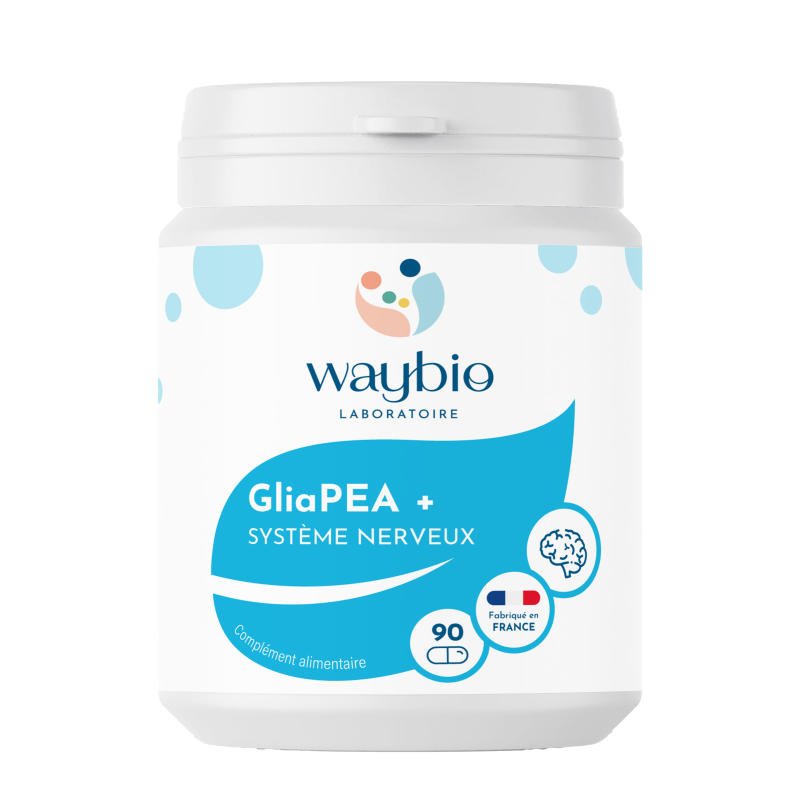
GliaPEA+ offers a deliberately simple formula centred on
a single active ingredient: palmitoylethanolamide, more commonly known as PEA. Three capsules provide
900 mg of PEA, or 300 mg per capsule. The dose can therefore be adjusted from
300 to 900 mg per day.
PEA, a messenger naturally produced by the bodyPEA belongs to the family of
N-acylethanolamines. It is a
lipid messenger naturally produced by the body and found in many tissues, notably around nerves, in muscles and within cells involved in the immune response.
Unlike fats mainly used as energy reserves, PEA
transmits information between cells. Its production increases locally when tissues are subjected to strain, irritation or unusual demands. It then contributes to the mechanisms used by the body to
contain an excessive response and return to more balanced function.
The body makes it from constituents found in cell membranes. After fulfilling its role, PEA is broken down by enzymes, mainly
FAAH and NAAA, into palmitic acid and ethanolamine. These elements can then be reused by cells.
A molecule studied since the 1950sPEA was first identified in
1957 in egg yolk, soybeans and peanuts. Its presence in mammalian tissues was then demonstrated in 1965. These discoveries gradually led to the understanding that it was not only a dietary constituent but also a
regulatory molecule produced by the body.
GliaPEA+ contains
plant-derived PEA sourced from olive oil.
How does PEA support comfort?When an area is regularly under strain, certain messengers can keep tissues and nerve fibres in an excessively alert state. A simple movement or pressure may then be perceived more intensely. Comfort therefore depends both on
the condition of the tissues and the way nerves transmit sensations.
PEA acts mainly by activating
PPAR-α, a receptor located inside cells. This receptor works like a switch capable of changing the activity of several genes involved in the tissue response. Its activation helps
limit the excessive production of certain inflammatory messengers and promote a return to a more stable cellular state.
PEA also helps moderate the activity of two important families of cells:
•
Mast cells, found in many tissues, can release substances that increase local sensitivity when excessively activated.
•
Glial cells surround and support neurons. Prolonged glial activity can sustain the amplification of nerve signals.
By helping regulate these cells, PEA acts at the
interface between tissue response and the transmission of sensations. This action explains its value for people dealing with
persistent sensitivity, tension or discomfort that disrupts everyday movement.
Particular value for sensitive jointsJoint discomfort does not depend on cartilage alone. The
synovial membrane, ligaments, surrounding muscles and small nerve fibres also contribute to perceived sensations.
PEA is not a constituent intended to rebuild cartilage. Its value is different: it helps
regulate local reactions and prevent discomfort signals from remaining unnecessarily amplified. This action can support
more comfortable mobility, notably when joints are sensitive, stiff or regularly under strain.
An influence on the perception of sensationsPEA also acts indirectly on the
endocannabinoid system and on
TRPV1, a receptor found on certain nerve fibres. TRPV1 contributes to converting heat, irritation or pressure into a nerve signal.
By modulating this system, PEA can help
reduce an overactive sensory response.
A formula adaptable to daily needsEach capsule provides
300 mg of PEA. Taking one to three capsules makes it possible to adjust the daily amount within the manufacturer’s recommendations:
•
1 capsule: 300 mg of PEA;
•
2 capsules: 600 mg of PEA;
•
3 capsules: 900 mg of PEA.
The format of
90 capsules therefore covers 30 to 90 days of use, depending on the selected dose. Divided intake can also make it possible to spread the amount throughout the day.
GliaPEA+ characteristics •
900 mg of PEA at the maximum daily dose of three capsules.
•
300 mg of PEA per capsule.
•
Plant-derived PEA sourced from olive oil.
•
A single active ingredient.
•
Adjustable dosage of one to three capsules per day.
•
90 vegetable capsules.
• Suitable for a
vegetarian and vegan diet.
•
No active substance of animal origin.
•
No micronisation or particular bioavailability technology is indicated.
Who is this product for?GliaPEA+ may be suitable for adults wishing to support their
joint, muscle or nerve comfort when tissues are regularly under strain. It may be relevant in cases of
persistent sensitivity, recurring tension, less comfortable mobility or after periods of sustained physical activity. Its adjustable dose will also appeal to people looking for a
single-active-ingredient, vegan formula that is easy to include in their daily routine.
What does the science say?A clinical trial on knee comfort and mobilityIn
2019, a team of Australian researchers assessed the value of PEA in adults with
knee discomfort associated with mild to moderate osteoarthritis.
The trial included
111 participants. It was conducted at a single centre using a
randomised, double-blind, placebo-controlled methodology.
For
eight weeks, participants were divided into three groups:
•
300 mg of PEA per day, divided into two intakes;
•
600 mg of PEA per day, divided into two intakes;
• an
identical-looking placebo.
The main criterion was the
WOMAC questionnaire, which assesses three dimensions:
pain, stiffness and difficulties with daily activities. The exact form or particle size of the PEA is not detailed in the accessible scientific abstract.
Compared with placebo, the total WOMAC score
improved significantly with 300 mg of PEA per day (
p = 0.0372) and with
600 mg per day (
p = 0.0012).
The results also showed:
• an
improvement in the WOMAC pain score with 300 mg (
p = 0.0074) and
600 mg (
p < 0.001);
• an
improvement in the stiffness score with 300 mg (
p < 0.049) and
600 mg (
p = 0.001);
• an
improvement in physical function with 600 mg per day (
p = 0.033);
• a
reduction in the highest- and lowest-pain ratings in both PEA groups.
No concerning changes in clinical markers were reported, and
PEA was well tolerated during the eight weeks.
This trial supports the value of an
oral intake of 300 or 600 mg of PEA in supporting
knee comfort, stiffness and function. These two doses correspond respectively to
one and two PEA Fort capsules.
Full reference: Steels E, Venkatesh R, Steels E, Vitetta G, Vitetta L.
A double-blind randomized placebo controlled study assessing safety, tolerability and efficacy of palmitoylethanolamide for symptoms of knee osteoarthritis. Inflammopharmacology. 2019;27(3):475-485.
DOI: 10.1007/s10787-019-00582-9 –
PubMed.





 Nervous system
.png) Expertise based on experience and science
Expertise based on experience and science.png) Certified products
Certified products The best of nature