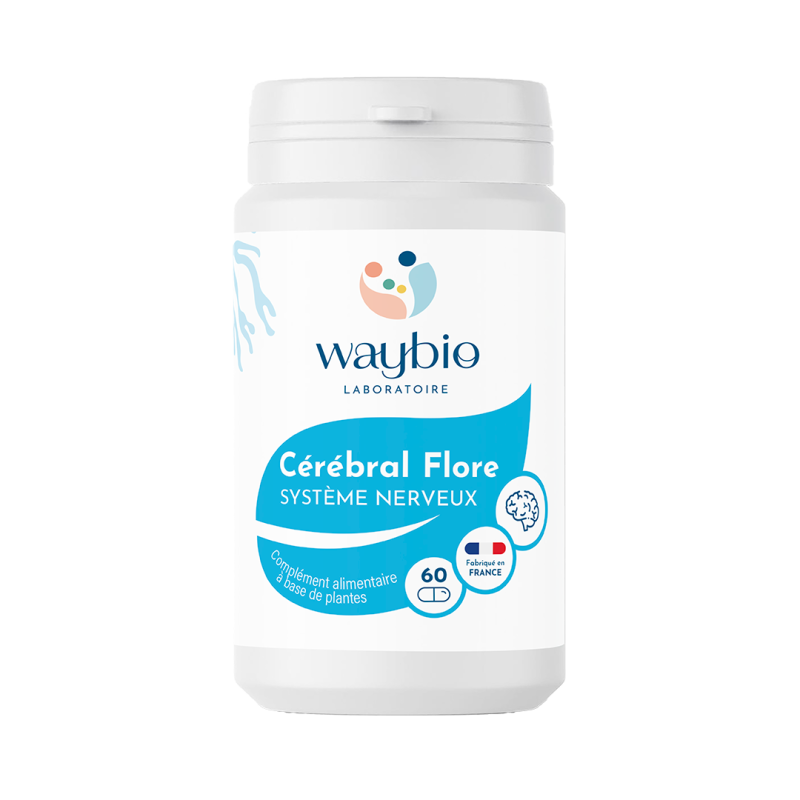
Cérébral flore offers a comprehensive approach to mental clarity by acting on several complementary components: the intestinal environment, communication between the gut and the brain, nerve cell activity and the mechanisms involved in memory and attention.
Two capsules provide 10 billion cultures distributed among nine strains, 120 mg of brahmi extract standardized to 20%, 250 mg of lithothamnion and 100% of the stated daily intakes of vitamins B1, B2 and B6.
Nine cultures at the heart of the gut–brain axis
The formula brings together various cultures of lactobacilli, bifidobacteria and lactococci. Their presence forms part of the intestinal ecosystem, which is not limited to digestion: the gut continuously exchanges information with the brain.
This communication uses several physiological pathways:
-
the vagus nerve, which transmits signals between the digestive tract and the central nervous system;
-
immune cells present in the intestinal mucosa;
-
enteroendocrine cells, which can release various messengers;
-
metabolites formed by microbiota activity, particularly short-chain fatty acids;
-
tryptophan metabolism, an amino acid involved in the production of several signaling molecules.
Short-chain fatty acids, such as acetate, propionate and butyrate, are mainly produced by the fermentation of dietary fiber by the microbiota. They contribute to the nutrition of intestinal cells, the integrity of the intestinal barrier and immune and metabolic exchanges between the gut and the rest of the body.
The inclusion of nine different cultures is therefore intended to support this complex environment. The acid-resistant plant-based capsules are designed to better protect the cultures as they pass through the stomach and promote their release farther along the digestive system.
Brahmi for memory, learning and attention
Brahmi, also known as bacopa or water hyssop, is an aquatic plant traditionally used in Ayurveda to support intellectual abilities. Cérébral flore provides 120 mg per two capsules in the form of an extract standardized to 20%.
Brahmi naturally contains various plant substances, including triterpenoid saponins known as bacosides. These compounds are associated with several mechanisms useful for brain function:
-
modulation of cholinergic transmission, in which acetylcholine is involved in attention, learning and memory;
-
supporting synaptic plasticity, the ability of connections between neurons to adapt and strengthen;
-
supporting the stages of encoding, consolidating and recalling information;
-
protecting cellular structures against oxidative stress.
Brahmi is therefore the active ingredient primarily responsible for positioning the formula around memory, attention and mental performance. Its presence is particularly coherent during periods of learning, sustained intellectual work or high cognitive demand.
Vitamin B1, essential for nervous energy
Vitamin B1, or thiamine, contributes to converting carbohydrates into usable energy. Once converted into thiamine pyrophosphate, it becomes a cofactor for enzymes essential to glucose use and mitochondrial function.
This function is particularly important for neurons, whose activity requires a continuous energy supply. Vitamin B1 therefore contributes to normal energy metabolism, the normal function of the nervous system and normal psychological function.
Vitamin B2, between energy and oxidative balance
Vitamin B2, or riboflavin, is converted in the body into FMN and FAD. These two coenzymes are involved in mitochondrial reactions that transfer electrons and produce cellular energy.
It contributes to the normal function of the nervous system and the maintenance of normal energy metabolism. It also helps protect cells against oxidative stress and reduce fatigue, complementing the action of brahmi during intellectually demanding periods.
Vitamin B6 and neurotransmitter production
Vitamin B6 is converted into pyridoxal-5’-phosphate, a coenzyme form involved in more than 160 enzymatic reactions. It contributes in particular to amino acid metabolism and the synthesis of nervous messengers such as serotonin, dopamine and GABA.
These neurotransmitters contribute respectively to emotional regulation, motivation, attention and balanced nervous excitability. Vitamin B6 therefore contributes to the normal function of the nervous system, normal psychological function and the reduction of fatigue.
Lithothamnion, a marine mineral matrix
Lithothamnion is a calcified red marine alga. As it grows, it naturally forms a mineral matrix within its walls. Cérébral flore contains 250 mg per two capsules to complement the micronutritional structure of the formula.
Complementarity at several levels
The value of Cérébral flore lies in its functional complementarity:
-
the nine cultures are included to support the intestinal environment and communication pathways of the gut–brain axis;
-
brahmi is the active ingredient primarily oriented toward memory, learning and attention;
-
vitamins B1 and B2 support the production of energy needed by nerve cells;
-
vitamin B6 contributes to amino acid metabolism and neurotransmitter synthesis;
-
lithothamnion provides the marine and mineral component of the formula.
This combination is not based on a stated mechanism of improved absorption between the ingredients. The verified delivery feature is the acid-resistant capsule, designed to protect the cultures during gastric passage.
Who is this product for?
Cérébral flore may be particularly suitable for:
-
students and people in periods of learning;
-
professionals facing a sustained mental workload;
-
people who wish to support their memory, attention and mental clarity;
-
periods of intellectual fatigue or temporary stress;
-
people looking for a formula combining the microbiota and brain functions;
-
vegetarians or vegans, according to the characteristics provided by the manufacturer.
What science says
A French clinical study published in 2011 examined two cultures belonging to species present in Cérébral flore: Lactobacillus helveticus and Bifidobacterium longum.
The aim was to determine whether their combination could influence daily stress, anxiety, mood and coping strategies in healthy adults.
The trial was randomized, double-blind and placebo-controlled. Fifty-five adults aged 30 to 60 completed it: 26 received the active preparation and 29 the placebo. The studied formula provided 3 billion colony-forming units of L. helveticus R0052 and B. longum R0175 daily, in a 1.5 g sachet, for 30 days.
Participants completed several questionnaires on psychological distress, anxiety, mood, perceived stress and the strategies used to cope with difficulties. Their 24-hour urinary cortisol was also measured.
After 30 days, the overall HSCL-90 psychological distress score decreased from a median of 49 to 25 in the active group, compared with 42 to 32 with placebo. The median reduction reached 44.4% with the cultures versus 30.7% with placebo, with a statistically significant difference.
Favorable differences were also observed in the somatization, depression and hostility subscores. The overall HADS score improved compared with placebo, while the anxiety-specific result was just above the usual statistical threshold.
Median urinary cortisol decreased in the active group, from 50.5 to 43.7 ng/ml.





 Nervous system
.png) Expertise based on experience and science
Expertise based on experience and science.png) Certified products
Certified products The best of nature