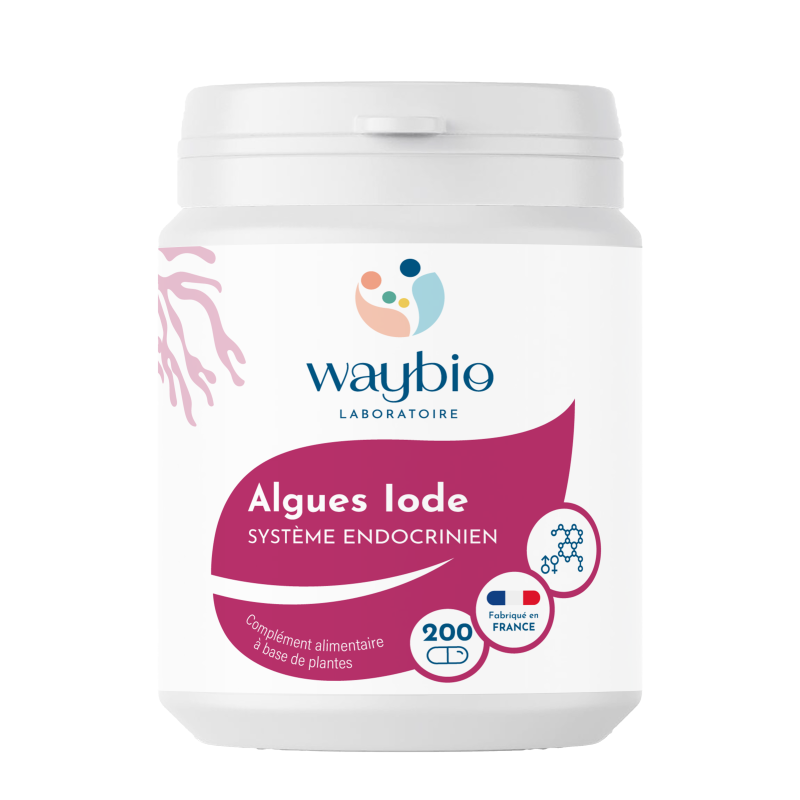
Algues Iode offers a
simple, precisely dosed marine formula: each plant-based capsule contains
280 mg of Fucus sp. and provides
150 µg of iodine. This intake represents
100% of the nutrient reference value established in the European Union for an adult. It also corresponds to
the adequate daily intake established by EFSA and ANSES.
Iodine, essential for thyroid functionOnce made available through digestion, iodine enters the bloodstream before being taken up by the thyroid. This gland uses it to produce the
thyroid hormones T4 and T3. These hormones do not directly produce energy: they help regulate the processes that allow cells to
use carbohydrates, fats and proteins to function normally.
Thanks to its supply of
150 µg per capsule, Algues Iode therefore contributes to:
• the
normal production of thyroid hormones;
•
normal thyroid function;
•
normal energy-yielding metabolism.
The aim is not to artificially “stimulate” the thyroid, but to provide it with a
micronutrient it naturally needs to perform its physiological functions.
Support for nervous and cognitive functionsThyroid hormones are involved in numerous exchanges between nerve cells and in the overall functioning of the brain. By contributing to an adequate availability of iodine, the formula supports the
normal function of the nervous system and the
maintenance of normal cognitive function, particularly attention, comprehension and memory.
Iodine also contributes to the
maintenance of normal skin. Its presence therefore enables this targeted formula to support several functions that depend on a
sufficient iodine intake, without multiplying the number of ingredients.
Fucus, a naturally iodine-rich marine matrixThe term
Fucus sp. refers to a seaweed belonging to the genus
Fucus. These
brown macroalgae live mainly on rocky coasts in temperate regions, in an area that is alternately submerged and exposed by the tides.
Their thallus—the entire visible part of the seaweed—naturally draws mineral elements from seawater.
Fucus is particularly known for
concentrating iodine. It also contains a matrix composed of
marine fibres, including alginates, as well as various polysaccharides and polyphenols.
An iodine source steeped in historyThe association between seaweed and iodine has a long history. The element iodine itself was
discovered in 1811 by the French chemist Bernard Courtois from seaweed ash. Certain
Fucus species, notably
Fucus vesiculosus, were subsequently used in dried and powdered form in various European preparations.
Formula features •
280 mg of Fucus sp. per capsule;
•
a controlled supply of 150 µg of iodine;
•
100% of the European nutrient reference value for iodine;
•
ingredients from organic farming;
•
Ecocert organic certification;
•
plant-based capsule;
•
a single daily dose;
•
long-lasting 200-day format.
The functions attributed to iodine are
recognised by the European regulation on health claims.
Who is this product for?Algues Iode may be particularly suitable for:
• adults whose diet contains
few natural sources of iodine, such as fish, seafood, certain dairy products or iodised salt;
• people looking for a
clearly defined daily intake rather than an unspecified iodine content;
• adults wishing to support the
normal production of thyroid hormones and energy metabolism;
• people attentive to the
normal function of the nervous system and cognitive functions;
• those who favour an
organic marine source in a concise formula;
• people looking for a supplement that is easy to incorporate into their routine, with
just one capsule per day.
What does the science say?In 2016, researchers at the University of Otago in Dunedin, New Zealand, studied the effect of a
daily intake of 150 µg of iodine in adults with a
mildly insufficient iodine status.
The clinical trial was
randomised, double-blind and placebo-controlled. It included
112 women and men aged 18 to 40. Their median urinary iodine concentration was initially
65 µg/L, a value corresponding to mild insufficiency in the group studied.
For
24 weeks, participants received daily:
• either
150 µg of iodine in the form of potassium iodate;
• or
a placebo.
After 24 weeks, the median urinary iodine concentration reached
168 µg/L in the supplemented group, compared with 79 µg/L in the placebo group. The difference was
statistically significant (p < 0.001).
Thyroglobulin concentration, a marker used to assess a population’s iodine status, had decreased by
12% after 8 weeks, 20% after 16 weeks and 27% after 24 weeks compared with placebo.
These results show that a daily intake of
150 µg of iodine can
measurably improve the iodine status of adults even when insufficiency is mild.
Full reference:Ma ZF, Venn BJ, Manning PJ, Cameron CM, Skeaff SA. “Iodine Supplementation of Mildly Iodine-Deficient Adults Lowers Thyroglobulin: A Randomized Controlled Trial.”
The Journal of Clinical Endocrinology & Metabolism. 2016;101(4):1737-1744.
DOI: 10.1210/jc.2015-3591 – PubMed.





 Endocrine system
.png) Expertise based on experience and science
Expertise based on experience and science.png) Certified products
Certified products The best of nature