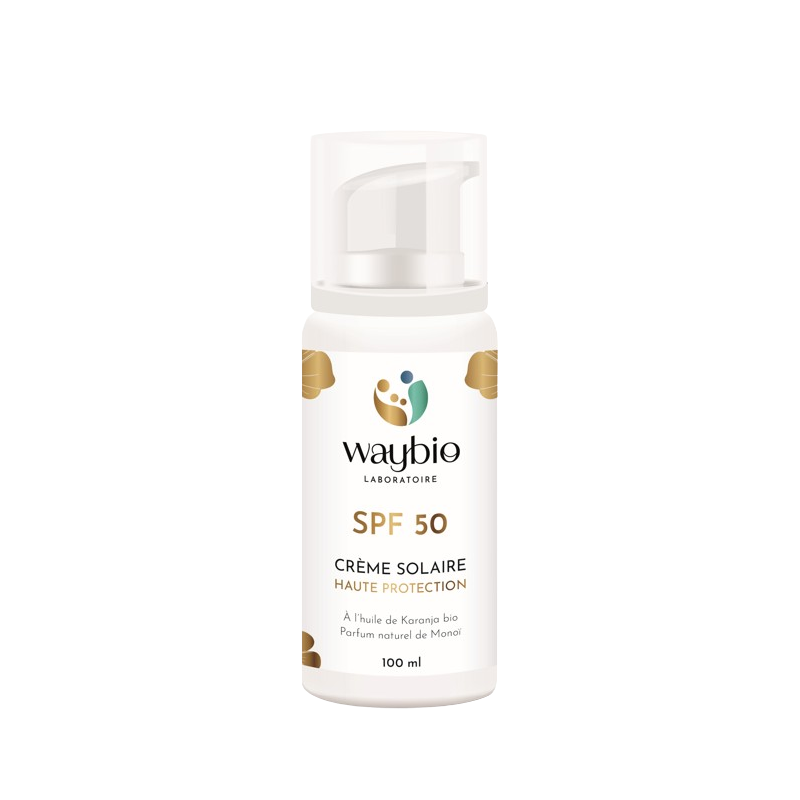
Our sunscreen combines
high SPF50 protection against UVA and UVB rays with a base of
plant oils and
microalgae extracts. Its fluid texture makes it easy to apply to the body, with a
monoï fragrance and a
white cast-free finish.
A mineral filter to limit the skin’s exposure to UV rays Zinc oxide, present in the form of
Zinc oxide [Nano], is the
sun filter in our formula.
It works primarily by
absorbing some ultraviolet radiation. Its action is therefore not limited to reflecting light: the particles intercept UV rays and dissipate their energy, reducing the amount of radiation that reaches the skin.
UVB rays are primarily responsible for sunburn.
UVA rays penetrate more deeply into the skin and contribute to changes associated with photoageing. Protection covering both categories of rays therefore helps preserve the skin during sun exposure.
SPF50 provides a high level of protection, measured under standardised testing conditions. Its actual effectiveness depends in particular on the
amount applied, the uniformity of the protective film and regular reapplication.
Sunflower and karanja: a plant-based foundation for supple skin Sunflower oil, Helianthus annuus seed oil, is the first ingredient in our formula. Its lipids provide an
emollient effect: they soften the skin’s surface and help maintain the comfort of the stratum corneum, its outermost layer.
This layer contains cells surrounded by lipids that help
limit water loss. The cosmetic benefits of sunflower oil lie particularly in its ability to
support this barrier function and improve skin suppleness.
Karanja oil, Pongamia glabra seed oil, complements this base as a skincare ingredient. Extracted from the tree’s seeds, it adds another oily component to the formula and contributes to its sensory feel.
Two microalgae with complementary pigments Our formula contains extracts of
Dunaliella salina and
Haematococcus pluvialis.
These two microalgae are distinguished by their
carotenoids, pigments naturally involved in protecting them against environmental stressors:
•
Dunaliella salina is particularly known for its ability to accumulate
beta-carotene;
•
Haematococcus pluvialis is especially notable for its production of
astaxanthin.
These pigments have
antioxidant properties: they can interact with certain reactive molecules and limit oxidation reactions. Their presence complements our formula’s approach to
sun protection and skincare.
Tocopherol: an antioxidant suited to the oil phase Tocopherol, a form of vitamin E, completes our formula.
Its fat-soluble nature allows it to act in lipid-rich environments. It helps to
interrupt certain chain reactions responsible for lipid oxidation, thereby contributing to the
antioxidant protection of the oil phase.
Vitamin E also plays a role in the
natural antioxidant defences of the skin’s surface. This benefit complements the action of the sun filter.
A texture designed for pleasant application Coco-caprylate/caprate provides an emollient feel and makes the product easier to spread. Hydrogenated castor oil contributes to its consistency, while polyglyceryl derivatives and isostearic acid help ensure the
dispersion and stability of the formula.
Who is this product for? Our sunscreen is suitable for anyone seeking
certified organic SPF50 body protection with a
mineral filter and a fragranced texture.
It can be used
from the age of two, as well as
during pregnancy and breastfeeding. However, babies and young children should not be exposed directly to the sun.
The benefits of this combination Our formula combines
three complementary functions:
•
Zinc oxide provides the sun-filtering action. •
Plant oils and emollients contribute to skin suppleness and make the product easier to spread. •
Microalgae extracts and tocopherol provide antioxidant compounds.
What the science says An
Australian trial published in 2013 examined the benefits of regular sunscreen use in
limiting visible skin ageing.
Conducted in Nambour between
1992 and 1996, the study involved
903 adults under the age of 55. Participants were randomly assigned either to daily use of a broad-spectrum sunscreen or to discretionary use. The protocol also separately evaluated beta-carotene supplementation against a placebo.
After
4.5 years, researchers observed
less pronounced signs of skin ageing in the group using sunscreen daily: the odds of progression were
24% lower than in the discretionary-use group.
The assessment was based on skin microtopography, examined by evaluators who were unaware of the participants’ group assignments. These findings support
the benefits of regular sun protection in limiting photoageing.
Reference: Hughes M. C. B., Williams G. M., Baker P., Green A. C.
Sunscreen and prevention of skin aging: a randomized trial.
Annals of Internal Medicine, 2013 ; 158(11) : 781–790.
DOI : 10.7326/0003-4819-158-11-201306040-00002.